How to Make a Nether Portal (No Diamonds Needed)
A Nether portal needs 10 Obsidian in a 4-wide, 5-tall frame with the corners left out, lit with Flint and Steel. No Diamond Pickaxe is needed.
There are three ways to get that Obsidian: mine it with a Diamond Pickaxe, cast it in place with buckets, or finish a ruined portal the world already built.
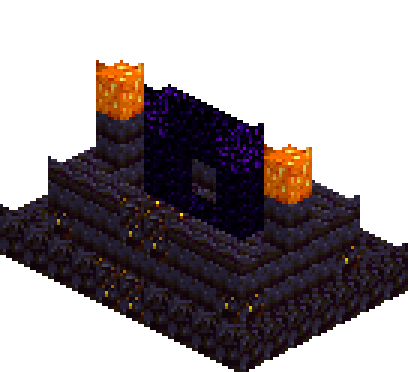
What to bring
| Item | How many | Notes |
|---|---|---|
| Obsidian | 10, or 14 with corners | Only if you mined or scavenged it |
| Flint and Steel | 1 | 1 Iron Ingot + 1 Flint, 64 uses |
| Water Bucket | 1 | Casting only |
| Bucket | 1 or more | One lava fill per Obsidian block |
| Dirt or Cobblestone | about 40 | Casting only, for the mould |
Casting needs 7 Iron Ingots in all: 1 for the Flint and Steel and 3 each for two Buckets. Flint comes from breaking Gravel, which drops it 10% of the time, or every time with Fortune III. Both recipes are on the Flint and Steel and Bucket pages.
Frame size and Obsidian count
The frame is a vertical rectangle, from 4 wide by 5 tall (a 2×3 opening) up to 23×23. The four corners never matter at any size, so you can leave them out, though portals the game builds always include them.
| Frame (outside) | Opening | Obsidian, no corners | With corners |
|---|---|---|---|
| 4 × 5 | 2 × 3 | 10 | 14 |
| 5 × 5 | 3 × 3 | 12 | 16 |
| 6 × 7 | 4 × 5 | 18 | 22 |
| 23 × 23 | 21 × 21 | 84 | 88 |
For any size, the cornerless count is 2 × (opening width + opening height). Add 4 for the corners.
Only Obsidian counts. Crying Obsidian looks close but will not form a frame, and a Nether portal cannot lie flat like an End portal.
Mining Obsidian with a Diamond Pickaxe
Obsidian drops only for a Diamond or Netherite Pickaxe. A plain Diamond Pickaxe takes 9.4 seconds a block, about a minute and a half for a 10-block frame. Underground, look where water has run over a lava pool: the lava surface there is often already Obsidian. Without diamonds, casting is quicker than finding diamonds first.
Casting a portal without a Diamond Pickaxe
The whole method rests on three rules:
- Water touching a lava source turns it into Obsidian.
- Water touching flowing lava makes Cobblestone.
- Lava flowing down onto water makes Stone.
So always pour the lava first, into a space it cannot spill out of, then bring the water to it. Each Obsidian block uses up one lava source, so refill as you go. Build the mould from Dirt or Cobblestone, not planks or wool: lava can set flammable blocks alight.
These steps build the 10-block frame on flat ground:
- 1.Cast the base. Dig two holes side by side, one block deep, where the bottom of the frame goes. Pour lava into both, then pour water on the ground beside them so it runs over the lava. Both turn to Obsidian. Pick the water back up.
- 2.Fill the opening. Stack six Dirt blocks in the 2×3 space above the base. This core is the inside wall of your mould.
- 3.Wall the columns. At each end of the core, build Dirt on the front, back and outer side of the column's spot, four blocks high. That leaves a slot one block wide and four deep. It is open at the top and, at the top level, toward the core, so some water spills harmlessly over the core.
- 4.Fill each slot from the bottom. Pour lava into the slot, then pour water in at the top so it runs down onto the lava. Pick the water up, let it drain, and repeat. Three Obsidian per side.
- 5.Cast the top. On top of the core, place Dirt in front of and behind the two top spots, and fill each slot's empty top space (a corner) with Dirt. Pour lava into both spots, then water over them, and pick the water back up.
- 6.Break out the mould, including all six Dirt blocks in the opening.
Finishing a ruined portal
Ruined portals are broken frames that generate in every Overworld and Nether biome except the Deep Dark. Netherrack, Magma Blocks and lava around a crumbling arch give them away, and the Seed Map shows the likely spots for your seed.
Open the chest first. It rolls 4 to 8 item stacks, plus a two-in-three chance of 1–2 Lodestone. In Java Edition:
| Chest contains | Chance per chest |
|---|---|
| Obsidian (1–2 per stack) | 46.4% |
| Flint and Steel | 46.4% |
| Fire Charge | 46.4% |
| Flint and Steel or Fire Charge | 72.7% |
| Flint (1–4) | 46.4% |
| Iron Nuggets (9–18) | 46.4% |
Nine Iron Nuggets make an Iron Ingot, enough for a Flint and Steel.
Fill the missing frame spots with Obsidian from the chest. In the Overworld you can cast the rest one slot at a time. Each Obsidian block in the structure has a 15% chance to generate as Crying Obsidian. In a corner that does no harm, because the game ignores corners, but one in the ring stops the portal lighting. Swap it for Obsidian.
Lighting the portal
Use Flint and Steel on the inside face of any frame block, or on the floor of the opening.
Other ways to light it:
- A Fire Charge, used the same way. It is single-use and needs Blaze Powder to craft, so early on it comes from ruined portal chests.
- Fire spreading into the opening from a burning flammable block beside it.
- A lightning strike or a fireball landing inside the opening.
The fire has to come last. Fire lit in an unfinished frame does nothing when you complete it, so put it out and light it again.
When it will not light, or goes out
If it will not light, check:
- A gap in the ring. A column one block short or a top row shifted by one.
- The wrong block. Crying Obsidian, or anything else standing in for Obsidian.
- Too big, or not a rectangle. The frame must be a rectangle no larger than 23×23.
- Mould left inside. Clear the whole opening before you strike.
- You are in the End. Nether portals cannot be activated there.
Explosions from creepers, TNT and Ghast fireballs destroy portal blocks, and so does placing a water or lava source in the opening. After an explosion, just relight it. After a fluid, pick the source up with a bucket first. Breaking any Obsidian in the ring switches the whole portal off until you replace it. Carry Flint and Steel and spare Obsidian in the Nether, where water evaporates and casting is impossible.
If a lit portal never takes you to the Nether, the "Allow Nether" game rule may be off. It replaced the old allow-nether server setting, and an operator can turn it back on with /gamerule allow_entering_nether_using_portals true.
Stepping through
Stand in the portal for 4 seconds in Survival and you are in the Nether. If no portal exists near the matching spot, the game builds one, corners included: on solid ground within 16 blocks if there is room, otherwise at the spot itself, on a small Obsidian platform that overwrites whatever is there. To choose where it lands, work out the spot with the Nether portal calculator and follow the portal linking guide.
Once the plain frame works, a Nether hub turns one portal into a network.