How to build the Nether Portal: The Basic Frame in Minecraft
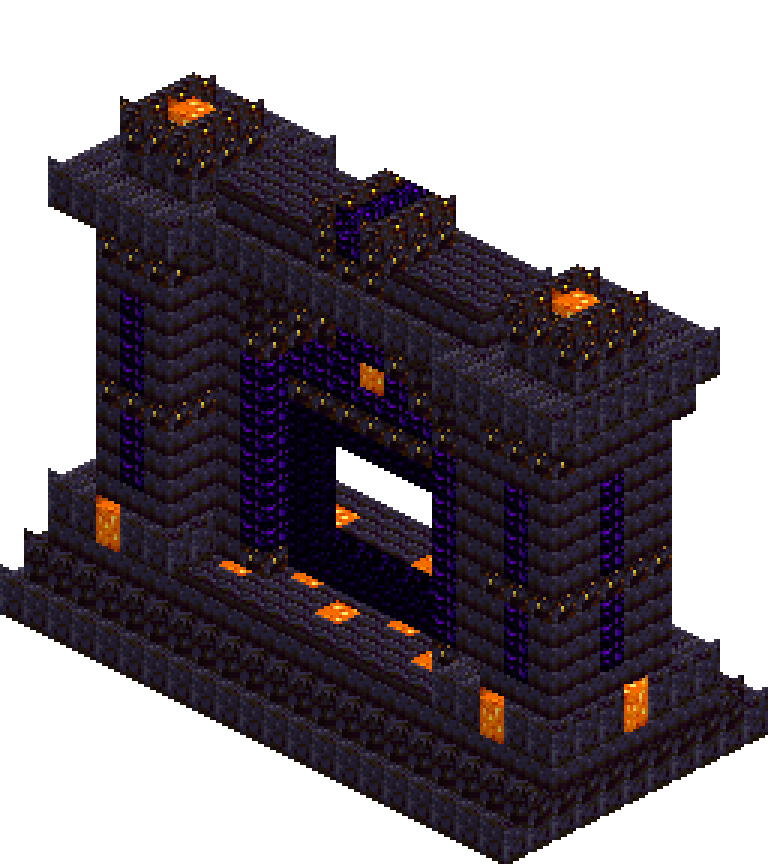
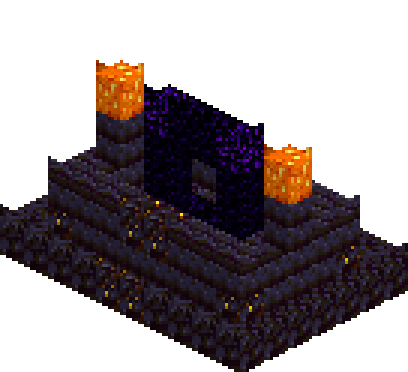
Every portal you will ever build is this shape. Four wide, five tall, a 2x3 hole in the middle — and only ten obsidian blocks are actually holding it together. The four corners are decoration, which is why a bucket-cast portal costs ten obsidian rather than fourteen. Putting it on a small blackstone deck costs nothing extra and turns a rectangle floating in a hillside into somewhere you arrive. The corners here are crying obsidian, so the four blocks you could leave out are obvious from across the room.
What you need
| Block | Count |
|---|---|
| Blackstone | 66 |
| Polished blackstone bricks | 40 |
| Polished blackstone | 14 |
| Gilded blackstone | 12 |
| Obsidian | 10 |
| Crying obsidian | 4 |
| Shroomlight | 2 |
Counts are exact for the model above. Mine a little spare — nobody places every block first time.
Building it
Each stage names the layers it covers. Drag the slider on the model to that layer and you are looking at exactly what the stage describes.
1.Slab first, then think about the frame
Ten by seven of plain blackstone, one block thick, across the whole footprint. Everything above sits inside it, so the outer edge reads as a plinth instead of a raw cut in the ground. Blackstone rather than stone or cobble, because the star of the build is obsidian and a grey base fights it — dark on dark keeps the eye on the frame. Two gilded blackstone go in at the centre of the front and back edges as a threshold. They cost nothing and they tell anyone walking up where the doorway is before they can see daylight through it.
2.The deck, inset one block
The deck is pulled in one block on every side, and that inset is the only real trick on this level: it leaves a visible lip of slab showing all the way round, so the platform reads as two courses rather than one flat pancake. Polished blackstone bricks around the perimeter, plain polished blackstone through the middle, gilded blackstone in the four corners. The bottom row of the portal goes in on this same level, flush with the deck rather than stacked on top of it, so you walk straight through instead of hopping a step on the way to the Nether.
3.The bottom pair and the two jambs
Two obsidian in the middle of the deck row, x=4 and x=5 on z=3. That is the base of the frame and it counts towards the ten. Then the jambs: three obsidian straight up each side at x=3 and x=6, y=2 through y=4. Three, not four — the block at deck level on each side is a corner, and corners are not part of the column. That is eight of the ten placed, and the gap between them is already the shape a portal wants: two wide, three tall, tall enough to walk through without crouching.
4.The lintel: block ten
Two obsidian at y=5, sitting directly over the bottom pair at x=4 and x=5. Ten blocks, and nothing else is needed — strike flint and steel against any inner face and it lights. If it refuses, the fault is nearly always a jamb one block short or a lintel offset by one, because the ten have to form an unbroken ring around the 2x3 void. One gap anywhere in that ring and the game sees a wall with a hole in it, not a portal.
5.The four corners you can leave out
Crying obsidian at the four corners: deck level on both sides, and both ends of the top row. Mine any one of them and the portal keeps burning, which is the entire point — they carry nothing. They are crying obsidian here so the optional four are visible at a glance, but crying obsidian lights as portal frame perfectly well, so plain obsidian works if you want the frame uniform. On a first trip through, skip them entirely and keep four obsidian in the bag for the return portal.
6.Kerb, pillars and two shroomlights
A low kerb of polished blackstone bricks along the back edge, wrapped one block round each corner, with two gilded blackstone in its centre lined up behind the frame. Then a pillar each side at x=1 and x=8, three blocks up, capped with shroomlight so the caps sit level with the lintel. The shroomlights are doing real work: a lit deck means nothing spawns on the tile you land on when you come back through at night, and warm orange against black obsidian is most of the reason this reads as a nether thing rather than a hole in a wall.
Make it yours
- Ten really is the number if obsidian is tight — build it cornerless, light it, go, and add the four corners later when you have a diamond pickaxe to spare.
- Prove which blocks matter without wasting flint and steel: break a corner and the portal keeps burning, break any of the ten and it goes out instantly.
- Crying obsidian lights as portal frame just fine, so it is used here purely as a marker. Swap all fourteen to plain obsidian if you want the frame to read as one solid slab.
- Swap the two shroomlights for sea lanterns if the portal sits in a snowy or icy biome — the orange glow reads as nether and looks jarring against white ground.
- 4x5 is the minimum, not the maximum. The same rules scale all the way to 23x23, and the corners stay optional at every size, so a big portal saves you proportionally more obsidian.