How to build the Gingerbread House in Minecraft
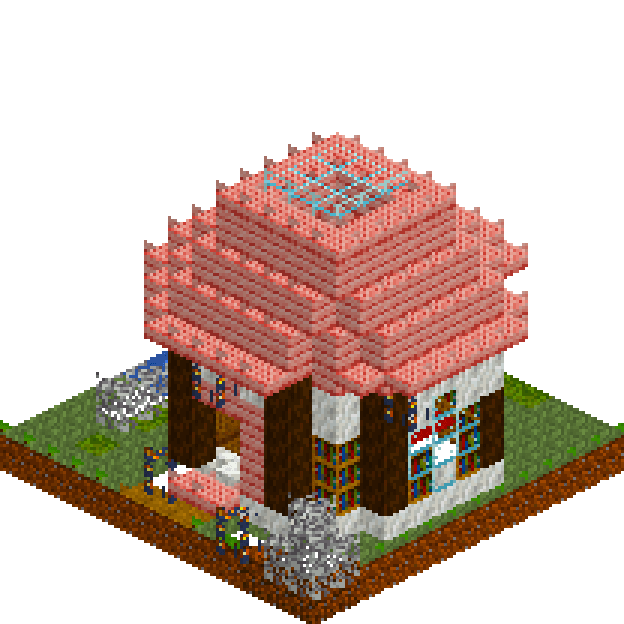
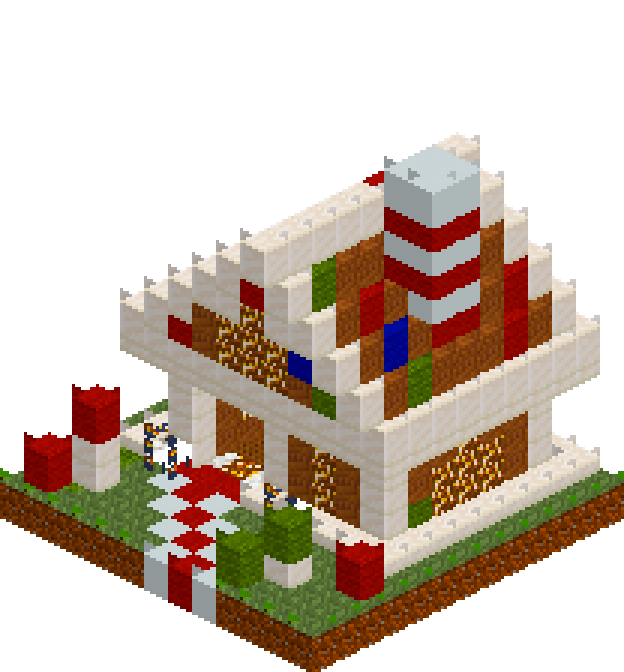
A gingerbread house is the one build where fussiness is the whole point: every edge gets piped, every flat panel gets a sweet stuck to it, and the thing is small enough to finish in an evening. Packed mud is a convincing biscuit brown, quartz does the icing, and glowstone in place of glass panes means the windows glow warm without a torch anywhere inside. The roof is deliberately left brown, with white tracing only the ridge, the verges and the eaves, so the piping reads as piping rather than snow.
What you need
| Block | Count |
|---|---|
| Packed mud | 288 |
| Quartz block | 113 |
| Quartz block slab | 67 |
| Calcite | 60 |
| Grass block | 52 |
| Red wool | 38 |
| Spruce planks | 35 |
| Glowstone | 28 |
| White concrete | 20 |
| Green wool | 8 |
| Moss block | 6 |
| Blue wool | 5 |
| Lantern | 2 |
| White wool | 1 |
Counts are exact for the model above. Mine a little spare — nobody places every block first time.
Building it
Each stage names the layers it covers. Drag the slider on the model to that layer and you are looking at exactly what the stage describes.
1.Sugar plate, peppermint path and a moss bed
The whole ground floor is one layer. A calcite plate covers x1-11 by z0-8, standing a block proud of the walls on every side so the house is never planted straight into turf, and spruce planks fill the room inside it. The path is three blocks of white concrete with a single red stripe down the middle, shifted one block sideways per row as it leaves the door; that slow drift is what makes it read as a curve rather than a plank. A moss bed sits to the left, a red mat on the threshold, and a glowstone in the doorway itself so warm light pools on the path before anything above it exists.
2.Biscuit walls and a door that eats the front
Four courses of packed mud on a 9x7 ring, x2-10 by z1-7, with quartz posts on all four corners and one more beside the door. The opening is three wide and four tall, pushed hard against the left corner post instead of centred: a small facade with a centred door reads as a model, an off-centre one reads as a house. Glowstone stands in for glass, a 3x2 arched pane on the right wall, a slit on the front and one at the back, and it lights the room for free. Quartz slabs skirt the base, two lanterns sit on the plate, and a pair of lollipops go in the bed.
3.The icing band and the overhanging eave
Course five is the piped icing: run the entire wall ring in quartz, lintel included, then ring it with quartz slabs one block out for a fascia that half-hangs. Lay the eave plate at y6 on top, solid packed mud across x1-11 by z0-8, a block proud on all four sides, with its whole perimeter swapped to quartz. That single overhanging course does more for the silhouette than anything else here. It throws a shadow line right across the walls and stops the box reading as a box.
4.A brown roof, iced only along its edges
Four shrinking courses and a ridge: x2-10, x3-9, x4-8, x5-7, then a single line at x6, each running the full depth z0-8. Leave every one of them brown. The temptation is to ice the whole roof, and a white roof turns into a wedding cake. Instead pipe the two verges with a diagonal line from the eave corner up to the ridge, cap the ridge itself in quartz, and let the biscuit show between. About twenty blocks of white do the work of two hundred.
5.Rose window, gumdrops and a candy-cane chimney
The gable end wants one oversized thing: a glowstone rose window three wide and two tall with a single block on top and quartz shoulders, sitting straight on the white eave band. Then scatter gumdrops, red and green and blue wool, only on the outermost block of each roof course and never two at the same depth, so they look dropped rather than tiled. Finish with the chimney at x8-9, z3-4: red wool banded with white concrete every other course, carried two blocks past the ridge, because a chimney slightly too tall is funnier than one in proportion.
Make it yours
- Packed mud is the block for the biscuit. Mud bricks give you a mortar grid that fights the icing, and dark oak reads as timber rather than gingerbread.
- Glowstone panes are the cheat that makes this glow in a screenshot. If you want real glass, put a redstone lamp or a shroomlight one block behind it instead.
- Keep the gumdrops on the exposed outer block of each roof course. A wool block set into the middle of a slope vanishes; on a step edge it catches light on two faces.
- Nudge the door left, the chimney right and the path off-axis. Perfect symmetry is what kills a small build: it stops reading as a place and starts reading as a model.
- Build the eave plate before any roof course. It sets the overhang everywhere at once, and every course above simply steps in one block from the one below it.