How to build the Snail Shell House in Minecraft
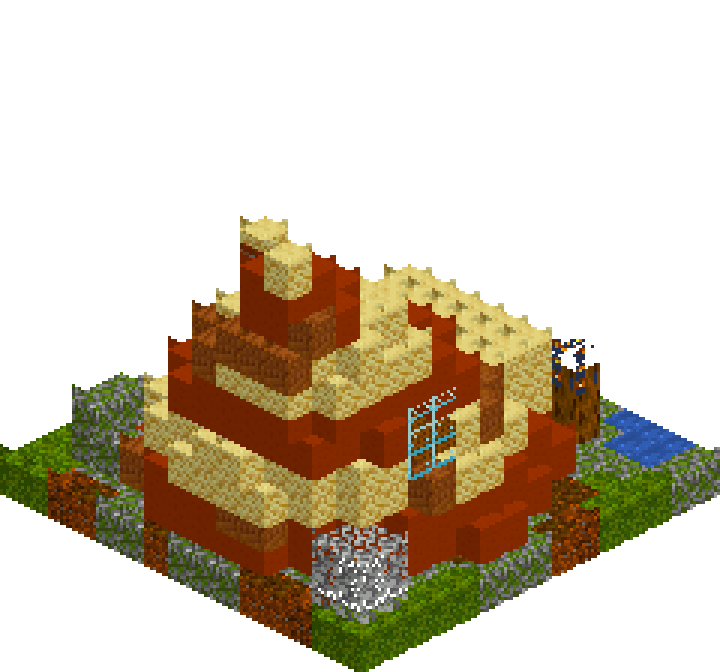
Fifteen blocks square, and it still reads as a snail from across the valley. The shell is eleven rings of terracotta and sandstone, each one a little smaller and a third of a block further back than the last, so the whole thing leans and the spire finishes out over the tail. The mouth is a proper three-block aperture with pale jambs and a slab porch, and the coil winds round a chiselled sandstone columella with a stair spiralling up it to a sleeping loft. Nothing here is fiddly: eleven circles, one cut, and a garden.
What you need
| Block | Count |
|---|---|
| Spruce planks | 98 |
| Terracotta | 94 |
| Sandstone | 82 |
| Mossy cobblestone | 66 |
| Podzol | 28 |
| Moss block | 26 |
| Sandstone slab | 23 |
| Packed mud | 17 |
| Coarse dirt | 9 |
| Dirt path | 9 |
| Oak leaves | 8 |
| Chiselled sandstone | 7 |
| Water | 5 |
| Oak log | 5 |
| Glass | 4 |
| Lantern | 3 |
| Bricks | 3 |
| Pumpkin | 2 |
| Shroomlight | 1 |
Counts are exact for the model above. Mine a little spare — nobody places every block first time.
Building it
Each stage names the layers it covers. Drag the slider on the model to that layer and you are looking at exactly what the stage describes.
1.The mossy plot and the plank floor
Lay the whole fifteen-by-fifteen plot in moss block, then cut the room's floor into it in spruce planks. That circle of planks is exactly what the ground whorl will sit around, so it doubles as your setting-out drawing — get it right here and the shell above builds itself. Break the join between shell and ground with a scruffy, half-broken ring of mossy cobblestone and podzol; a clean edge makes the shell look dropped on the lawn rather than grown out of it. Finish with a dirt path swinging away to the left of the door and a little pond in the right-hand corner.
2.First whorl, and the mouth of the shell
Three rings, each a block smaller than the last. Draw the widest as a closed circle of terracotta about eleven across, then take three blocks out of the front for the mouth — always cut after the ring is closed, never leave a gap as you go, or the circle wanders. Each ring above steps back a block, so its opening sits a block deeper and the aperture becomes a stepped tunnel rather than a flat hole, which is how a real shell mouth looks. Frame it with sandstone jambs so pale stone reads against the terracotta, stand the chiselled sandstone columella at the centre, and start the stair winding round it: slab, full block, slab.
3.Porch, porthole and the rising bands
The bands turn to sandstone at y4 and back to terracotta at y5, two layers each — single-block stripes turn to mush at any distance, doubled ones read as a shell. Roof the doorway with a sandstone slab awning three deep, running it a block wider to the left than the right and propping that end on an oak log post; the lopsided overhang is what stops the front reading as a model. Punch a two-by-two glass porthole through the right flank at y4-5, and floor the back of the shell at y5 in spruce planks for a sleeping loft the stair now arrives at.
4.The spire and the little chimney
From here each ring loses half a block of radius and gains a third of a block of lean, so the last layers pile up over the tail rather than over the door: a ring of eight, then four, then a single block for the tip. Keep the packed mud suture turning as you climb — about a fifth of a turn per layer, two blocks wide — and it spirals up the cone on its own, doing the work of a hundred hand-placed blocks. Last, a brick chimney standing on the left flank at y6, three tall and capped with a slab: far too tall for the house, which is the point.
5.Lanterns, pumpkins and a mossy boulder
Warm light, all of it low. A lantern hangs under the left corner of the porch, another sits on a short oak post beside the pond, and a shroomlight tucked just inside the doorway pushes light back out through the mouth — no outside lamp can do that. Then the small stuff that sells the whole thing: two pumpkins in a coarse dirt patch to the left of the path, a mossy cobblestone boulder and an oak leaf bush at the back corners, and one lantern on the floor at the back of the room so the mouth glows rather than gapes.
Make it yours
- Draw each whorl as a full circle first, then delete every block that no longer touches open air — you get a closed one-block ring with none of the diagonal holes you would otherwise spend ten minutes patching.
- Keep the colour bands two layers deep: terracotta at y1-2, sandstone at y3-4, terracotta at y5-6. Single-block stripes read as noise from ten paces; doubled ones read unmistakably as a shell.
- The lean is the whole trick. Every ring shifts about a third of a block towards the back as it shrinks, so the front slopes gently away from the door and the spire finishes over the tail, exactly where a snail carries it.
- Two blocks is the right width for the packed mud suture. Any wider and it reads as a stain rather than a seam, and the spiral you have gone to the trouble of rotating stops being legible.
- Slab the porch rather than roofing it in full blocks — the doorway keeps its full three-block height underneath, and the half-height brow makes the aperture look flared rather than boxed in.