How to build the Strawberry House in Minecraft
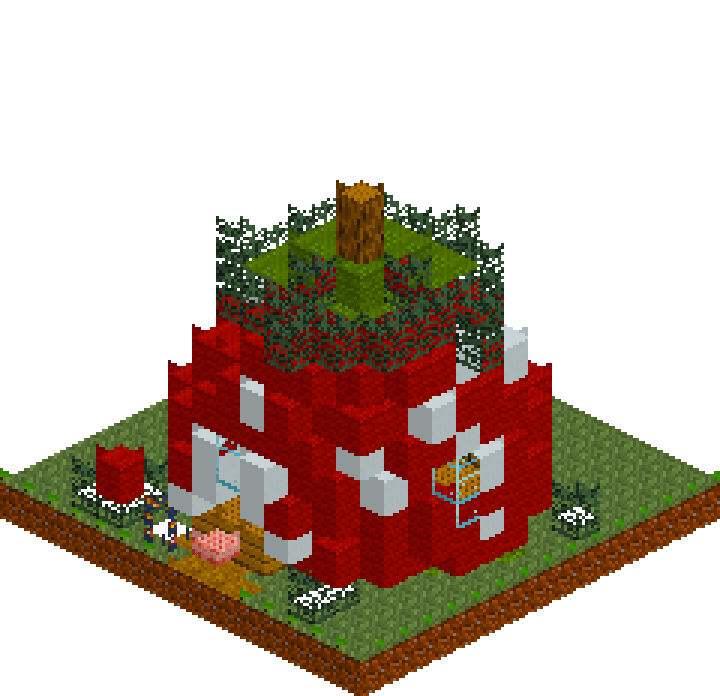
A strawberry roughly the size of a small cottage, with a door in it. The body is a red wool dome flecked with white concrete seeds, the roof is a green collar fringed with leaves, and a stubby log stalk pokes out of the top. Every course is a stepped circle, so there is not a straight wall anywhere, and the whole thing goes up in about twenty minutes. The joy of it is how little work the joke takes: get the circles right, scatter the seeds unevenly, and anyone walking past knows exactly what it is before they reach the gate.
What you need
| Block | Count |
|---|---|
| Grass block | 206 |
| Red wool | 153 |
| Oak planks | 64 |
| Spruce leaves | 38 |
| Green wool | 34 |
| White concrete | 31 |
| Glass | 8 |
| Coarse dirt | 7 |
| Moss block | 6 |
| Dirt path | 6 |
| Lantern | 4 |
| Oak log | 2 |
| Cherry planks slab | 1 |
| Bookshelf | 1 |
| Crafting table | 1 |
Counts are exact for the model above. Mine a little spare — nobody places every block first time.
Building it
Each stage names the layers it covers. Drag the slider on the model to that layer and you are looking at exactly what the stage describes.
1.Ground, garden and floor
Lay the whole 15x15 plot in grass first, then break it up: a dirt path bending away from the door rather than running dead straight at it, a bed of coarse dirt on the left for the strawberry plants, and moss dropped in at random so the lawn is not one flat green. On y=1 comes the floor, an oak plank disc ringed in red wool and drawn one block narrower than the walls that go above it, which is what makes the berry bulge out over its own base. The leaf bushes, the pink slab doorstep and the first lantern all sit on this layer too.
2.Bulge the berry out
Three courses of red wool, drawn as circles rather than walls: 11 wide at y=2 and y=3, then a rounder 11 at y=4 where the corners start pulling in. Cut the door out of the front face as you go, three blocks wide at the bottom and one at the top so it reads as a mouse-hole arch, with a single glass block above it for a porthole. The big 2x2 window goes on the left at x=2 and a smaller one on the right at x=12, deliberately not opposite each other. Scatter white concrete seeds over all three courses: never two touching, never in a line.
3.Curve the dome back in
Each course now steps inward by exactly one: 9 wide, 9 rounded, then 7. Work off the circle below rather than eyeballing it, because a dome that jumps in by two anywhere reads as a mistake and one that never steps in reads as a bucket. Keep speckling as you climb, thinning the seeds slightly near the top the way they thin on a real berry. A lantern hangs in the middle of the top course, so once the roof closes the interior glows out through both windows and the doorway.
4.Cap the berry, hang the leaves
y=8 is a solid 5-wide disc of red wool, and it seals the roof exactly, with no gaps left to patch from the inside afterwards. Then the calyx: a 7-wide collar of green wool at y=9, fringed all the way round in spruce leaves so the edge is ragged instead of cut, with four leaf points reaching out further than the rest. Three of those points drop a leaf back down to y=8, which stops the collar sitting on the berry like a dinner plate and makes it droop over the shoulders instead.
5.Crown and stalk
A smaller green cluster at y=10 lifts the centre of the crown so it is not a flat lawn, and two oak logs at y=11 and y=12 make the stalk, deliberately too long for the fruit, which is most of the joke. Stand back at ground level and check the log breaks the skyline on its own. If the crown looks too tidy, take one leaf off an arm and put it somewhere else: a lopsided calyx reads as grown, a perfectly symmetrical one reads as printed.
Make it yours
- Red wool is the cheapest bold red in the game, and it takes lantern light far better than terracotta or concrete does. One flower forest gives you dye for the whole dome.
- Keep the white seeds off the stepped corners of each circle. Speckles land best on flat runs of wall; on a corner they read as damage rather than decoration.
- Building on a slope? Flatten the y=0 grass disc first. The overhang at y=2 only reads as a bulge if the base underneath it is genuinely level.
- Leaves render darker than green wool, so keep them to the fringe of the crown. An all-leaf calyx loses its silhouette against the red once you walk twenty blocks away.
- Change the palette, not the shape, and you have an orchard: green with white seeds is a kiwi, purple with no seeds is a plum, sandstone with brown flecks is a pear.