How to build the Pirate Galleon in Minecraft
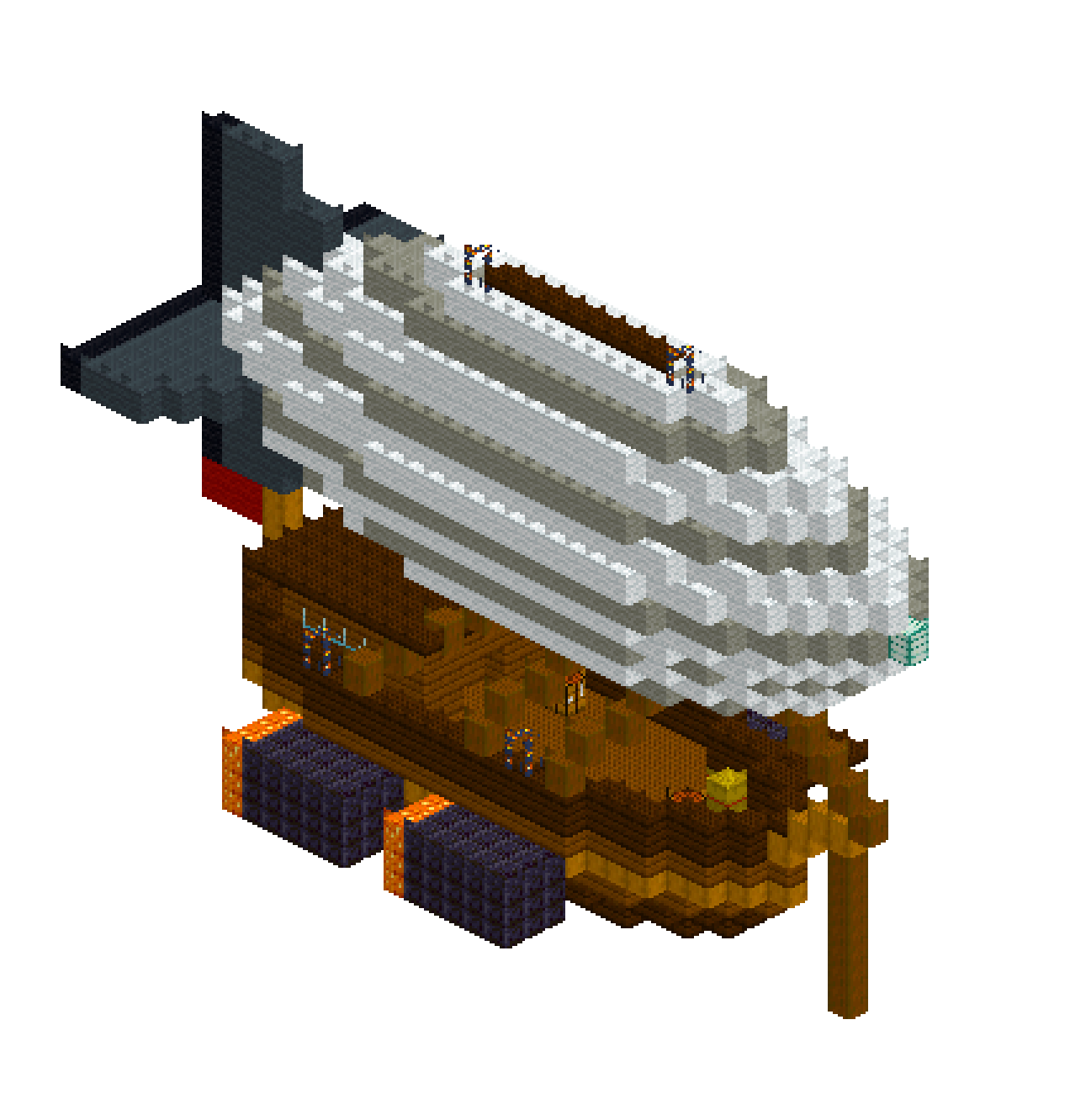
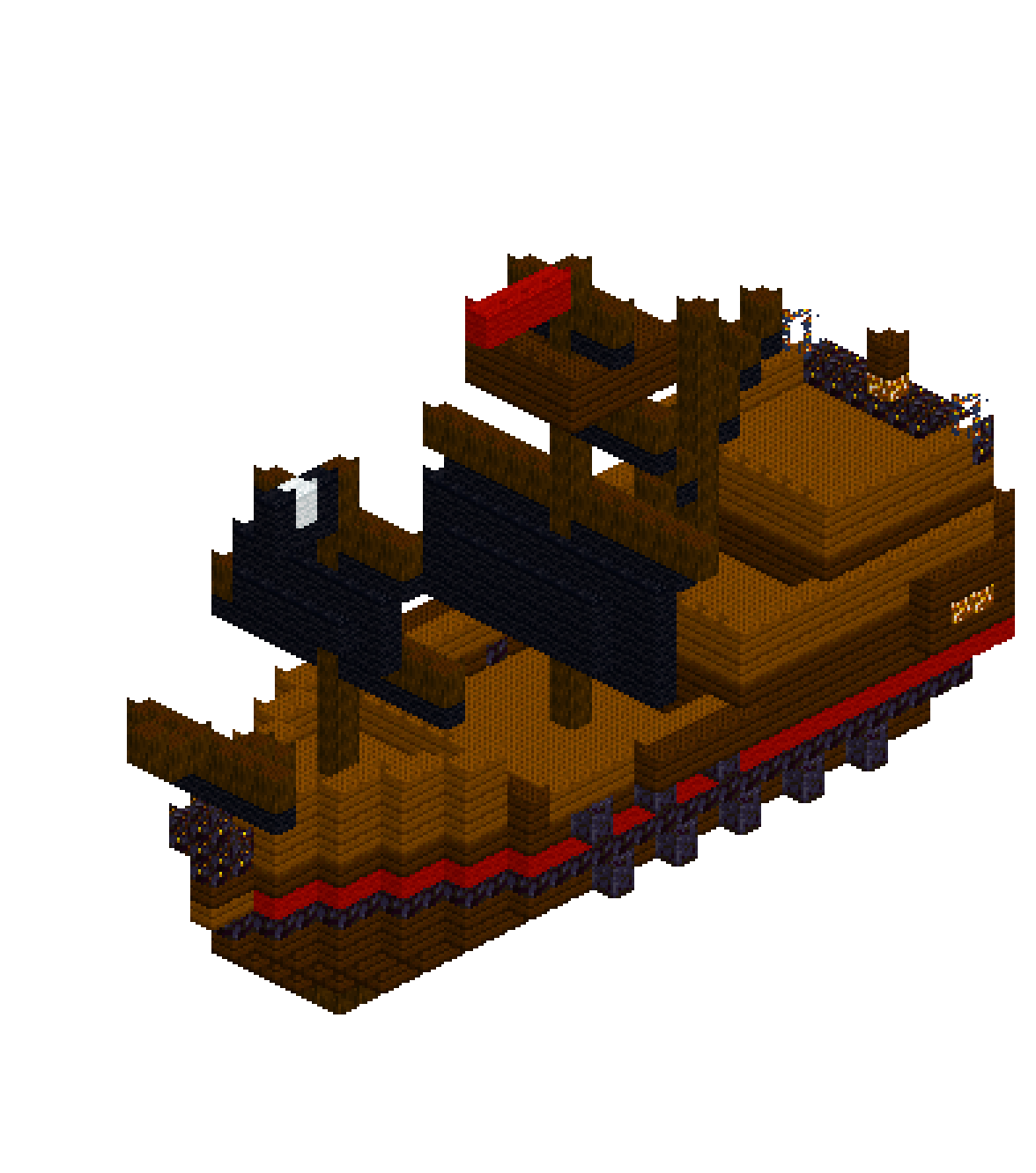
A thirty-six block ship built the way a real one is: cross-section by cross-section, each slice of the hull a block wider and a block longer than the one beneath it, until the planking swells out of the keel and curls back into a stem. She carries five guns run out through each flank, a stepped stern castle with a great cabin burning behind glowstone windows, gilded quarter galleries, and three masts of black canvas — mostly furled on the yards, with the main course and fore topsail loosed and drawing. Almost the entire vessel goes down in fifteen layer ops, which is exactly why the curves hold instead of collapsing into stacked boxes.
What you need
| Block | Count |
|---|---|
| Dark oak planks | 1025 |
| Spruce planks | 613 |
| Blackstone | 305 |
| Dark oak log | 193 |
| Black wool | 158 |
| Red wool | 66 |
| Glowstone | 29 |
| Gilded blackstone | 21 |
| Polished blackstone | 16 |
| Lantern | 2 |
| White wool | 1 |
Counts are exact for the model above. Mine a little spare — nobody places every block first time.
Building it
Each stage names the layers it covers. Drag the slider on the model to that layer and you are looking at exactly what the stage describes.
1.Keel, garboard and the turn of the bilge
A single line of dark oak log at y=0 is the keel — twenty blocks of it, z=7 to z=26. Everything above is a stack of horizontal slices. y=1 is three wide, y=2 five, y=3 seven, y=4 nine, and each slice is also longer than the one below it, reaching a block further fore and aft. That double growth — wider and longer at the same time — is what makes the hull read as a curve instead of a wedding cake. Round the ends of every slice as well: taper the last two or three rows down one pair at a time so the plan comes to a point rather than a chisel.
2.Full beam, the black wale and gun ports
y=5 reaches the full eleven-block beam and holds it through the long middle of the ship. Punch the gun ports in the same op: at z=7, 10, 13, 16 and 19 swap the outermost plank on each side for blackstone, then hang a polished blackstone block one further out at x=0 and x=12 — a muzzle run out through the port, and it costs nothing because it lives inside the layer you were already drawing. y=6 repeats that plan entirely in blackstone: one black band the whole length of the flank, the strongest single line on the ship. y=7 is the deck in spruce with a red wool ring around its outer edge — the painted riband, visible only from the water.
3.Bulwarks, the open waist and forecastle
From here up the layers stop being solid and become outlines. y=8 is the bulwark, just the two edge columns, except at z=12 and z=22 where a full row becomes a bulkhead, and at z=14, 17 and 20 where three more guns run out over the rail. y=9 caps it in spruce so a pale line follows the sheer the whole way round, and adds a small plank channel at x=0 and x=12 across z=13 to z=17 where the shrouds would land. y=10 roofs the forecastle in spruce from z=23 forward; y=11 lays the quarterdeck across z=0 to z=12 and rails the forecastle. Carve the two doorways last — three wide, two tall — or you will spend the evening filling them back in.
4.Stern castle, galleries and gilt
The stern steps up twice. The quarterdeck sits at y=11; above it a smaller poop cabin runs y=12 to y=13, pulled a block in from each side and stopped short at z=7, decked at y=14 and railed at y=15. Glow does the rest of the work. Glowstone fills the transom at y=9–10 and again at y=12–13, so the great cabin and the poop both burn from inside and the whole stern becomes the brightest thing on the water. Bolt a quarter gallery onto each flank — a plank box at x=0 and x=12 across z=1 to z=4 with glowstone at its centre — then a gilded blackstone name board under the quarterdeck and a gilded taffrail crowning the poop, with a glowstone stern light and two hanging lanterns above it.
5.Three masts, the fighting top, the bowsprit
Mainmast at z=15 from y=8 to y=28, foremast at z=26 from y=11 to y=24, mizzen at z=9 from y=12 to y=23 — the heights stagger deliberately so the outline reads tall amidships and falls away fore and aft. Yards are single lines across x: thirteen blocks for the main course at y=18, nine at y=23, five at y=27. The mizzen carries a lateen, one diagonal line from [6,14,12] up to [6,22,6], and that raked spar does more for the silhouette than any vertical on the ship. The bowsprit is the same trick forward, [6,12,29] out to [6,16,35], with a spritsail yard crossing it at y=14. Finally a five-by-five fighting top at y=24 with a rail at y=25, threaded onto the mainmast.
6.Black canvas, gilt prow and colours
A furled sail is one row of black wool directly beneath its yard, nothing more — do the main topsail, topgallant, fore course and spritsail that way. Then loose two, because a ship with every sail stowed is a ship asleep. The main course hangs y=12 to y=17: its head on the yard plane at z=15, its body one block forward at z=16, and a belly at z=17 so the canvas curves with the wind. The fore topsail does the same across z=27 and z=28. Place all the wool before the masts, so the mast lines run through afterwards and stitch the timber back together. Finish with a gilded blackstone figurehead at the stem, a red pennant streaming forward from the maintruck, and a black flag with a single white block at the fore.
Make it yours
- Sink her into water up to y=6 and the blackstone wale sits exactly on the waterline — that one alignment is what sells a ship as floating rather than parked.
- Layer rows always begin at z=0, so count the empty rows at the head of each slice as carefully as the solid ones; a single row out of place shears the whole hull sideways and you will not spot it until the masts refuse to line up.
- Dark oak slabs pressed into the notches where the bow steps in — z=23, 25, 27 and 29 — halve every corner and turn a visible staircase into something that reads as a curve.
- Rigging is the one thing this palette cannot do: run ladders or fences from the channels at y=9 up to the fighting top afterwards and the shrouds finally make the masts look tethered.
- Resist lighting the decks. Keep the only glow at the stern gallery and the two quarter lanterns so she reads at night as a black hull with a burning cabin, which is far more menacing than an evenly lit boat.