How to build the Volcano Lair in Minecraft
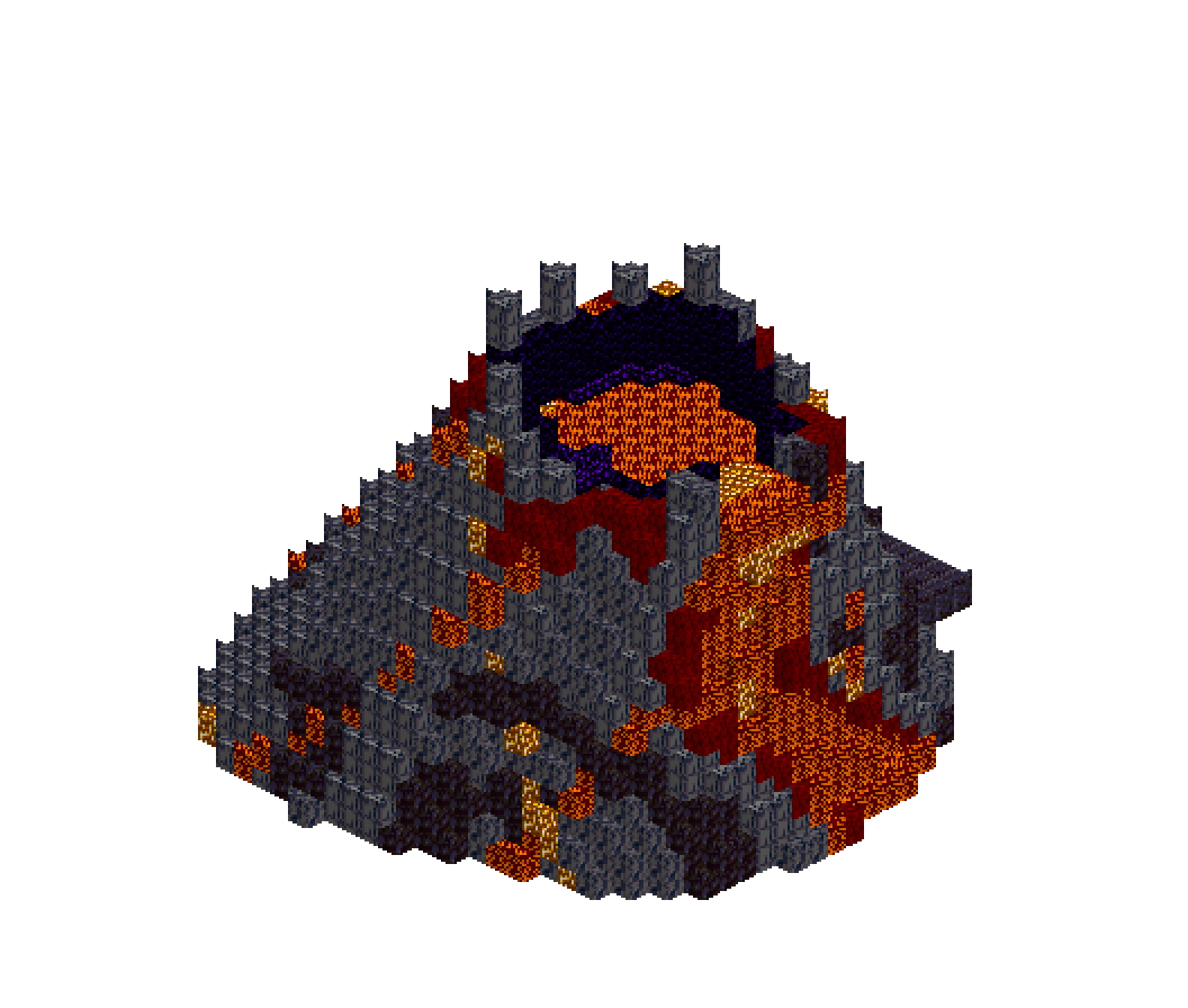
A volcano is the rare landmark that is also a house. This one rises 22 blocks to a lopsided crater rim, ridged and gullied down every flank, netherrack burning through the rock near the summit and a magma lake sunk into the vent like a lid. The rim is breached on one side, and the lake pours out of that notch as a glowing channel that meanders all the way down to the skirt. The whole cone is hollow: a hall twenty blocks across, lit from above by the lake it holds up, entered through a pair of blackstone doors parted just wide enough for one player at the back of a courtyard cut into the mountain's foot.
What you need
| Block | Count |
|---|---|
| Polished blackstone | 957 |
| Basalt | 725 |
| Blackstone | 524 |
| Magma block | 424 |
| Smooth basalt | 330 |
| Obsidian | 279 |
| Gilded blackstone | 120 |
| Netherrack | 116 |
| Glowstone | 93 |
| Crying obsidian | 63 |
| Shroomlight | 6 |
| Polished blackstone bricks | 4 |
Counts are exact for the model above. Mine a little spare — nobody places every block first time.
Building it
Each stage names the layers it covers. Drag the slider on the model to that layer and you are looking at exactly what the stage describes.
1.Skirt disc and lair floor
Everything starts with one cross-section. Lay y=0 as a solid disc about 29 blocks across, and resist the urge to make it circular — the outline should bulge on the back-left, where a broad buttress ridge will run, and pinch elsewhere. Inside the disc, the floor is already the lair: polished blackstone paving, a gilded blackstone ring, and a magma pool nine blocks wide at the centre. From y=1 upward the disc becomes a ring — a shell four blocks thick — and that hollow is the whole interior. Never fill the cone solid; it costs twelve thousand blocks and gains nothing.
2.Ten cross-sections of flank
Each layer is the same ring with a slightly smaller radius, and this is where the shape is won or lost. Three rules: the radius drops roughly half a block per level on a concave curve, so the base flares and the upper cone runs straight; the centre drifts about one block in x every nine levels, so the summit sits off-axis and the cone leans; and the radius wobbles a block or two with bearing, twisting slowly as it climbs, which turns flat cone sides into ridges and gullies. Wall thickness thins from four to under three as you rise. Basalt, smooth basalt and blackstone in patches two or three blocks wide — never speckled block by block — with thin magma veins where the seams run vertically.
3.Obsidian throat and magma lake
At y=12 the inner face changes material: polished blackstone gives way to obsidian with patches of crying obsidian, and the hollow stops being a room and becomes a throat. At y=14 that throat is capped — fill the entire opening with magma block flecked with glowstone. This single layer does three jobs: it is the glowing lake you see from the rim, it is the ceiling that lights the hall below, and it is the source the spillway drains. It needs support, so the three interior pillars are built before it. Above the lake the bowl continues, lined in obsidian, wall thickness down to two.
4.The breached rim and its horns
The rim is not level. Its height varies with bearing: highest at the back, where it reaches y=19, sagging three or four blocks toward the front, where a sector roughly forty degrees wide is cut away entirely above the lake. That gap is the breach, and it is the single most important piece of negative space in the build — it lets you see the lake from outside and gives the lava somewhere to go. Finish with five basalt spikes, one to three blocks tall, on the tallest arc of rim only. Two blocks of asymmetric spike does more for a silhouette than another five of cone.
5.The lava channel down one flank
Now go back down the outside. Starting at the breach lip, carve a groove one block deep into the skin and fill it two deep with magma block, following a centreline that snakes left then right as it descends — about seventeen degrees of meander each way. Widen it as it drops: a couple of blocks across at the rim, five or six where it fans into a delta at the foot. Flank the magma with netherrack banks, and speckle glowstone down the middle third only. Because it is recessed rather than laid on the surface, it reads as a channel cut by the flow and not as a stripe of paint.
6.The hidden door
Cut a courtyard nine wide and eight tall straight into the skirt on the opposite side from the channel, which leaves a sheer rock face standing at z=5. Set a panel of polished blackstone bricks into that face, framed with gilded blackstone jambs and a lintel, and bore a five-wide, five-tall arch through it into the hall. Then close it: two slabs of polished blackstone, two blocks wide each, leaving a single-block gap at the centre — doors caught half open, with light from the hall showing through the slot and the fanlight above. Shroomlight strips either side, paving on the approach.
7.Inside the cone
The hall is twenty blocks wide and thirteen tall, so it needs verticals. Three obsidian pillars, two by two, capped with crying obsidian at y=13, stand asymmetrically about the floor and carry the lake. A polished blackstone causeway runs from the door to the lip of the magma pool. Two magma columns hang from the lake like stalactites where nothing supports it. Everything else is left dark and empty on purpose: the light comes from the ceiling and the pool, so the pillars throw long shadows up the obsidian walls.
Make it yours
- There is no lava block in this palette, and that is a mercy: magma block flecked with glowstone reads as molten rock from ten blocks away, will not set fire to the netherrack around it, and can be crossed while sneaking. If you want real lava, pour it into the channel last, after every other block is placed.
- Never draw a perfect circle. Shift the centre of each cross-section a block every four or five layers and let the radius wobble a block or two with bearing — regular rings read as a wedding cake, irregular ones read as rock.
- Where the radius drops two blocks in one level the flank steps like a staircase; blackstone and tuff slabs along those terrace edges halve it. Use them on the outer skin only and leave the crater rim jagged.
- Build the shell, not the mountain: four blocks of wall at the base tapering to two at the rim is plenty, and the void you leave behind is the lair. Fill a cone this size solid and you spend twelve thousand blocks on nothing anyone will ever see.
- Keep light discipline. The only glow is the lake, the channel, the veins and the doorway — light the hall from its ceiling alone and leave the outer flanks completely dark, so the magma seams are the only thing the eye finds at night.