How to build the Orbital Station in Minecraft
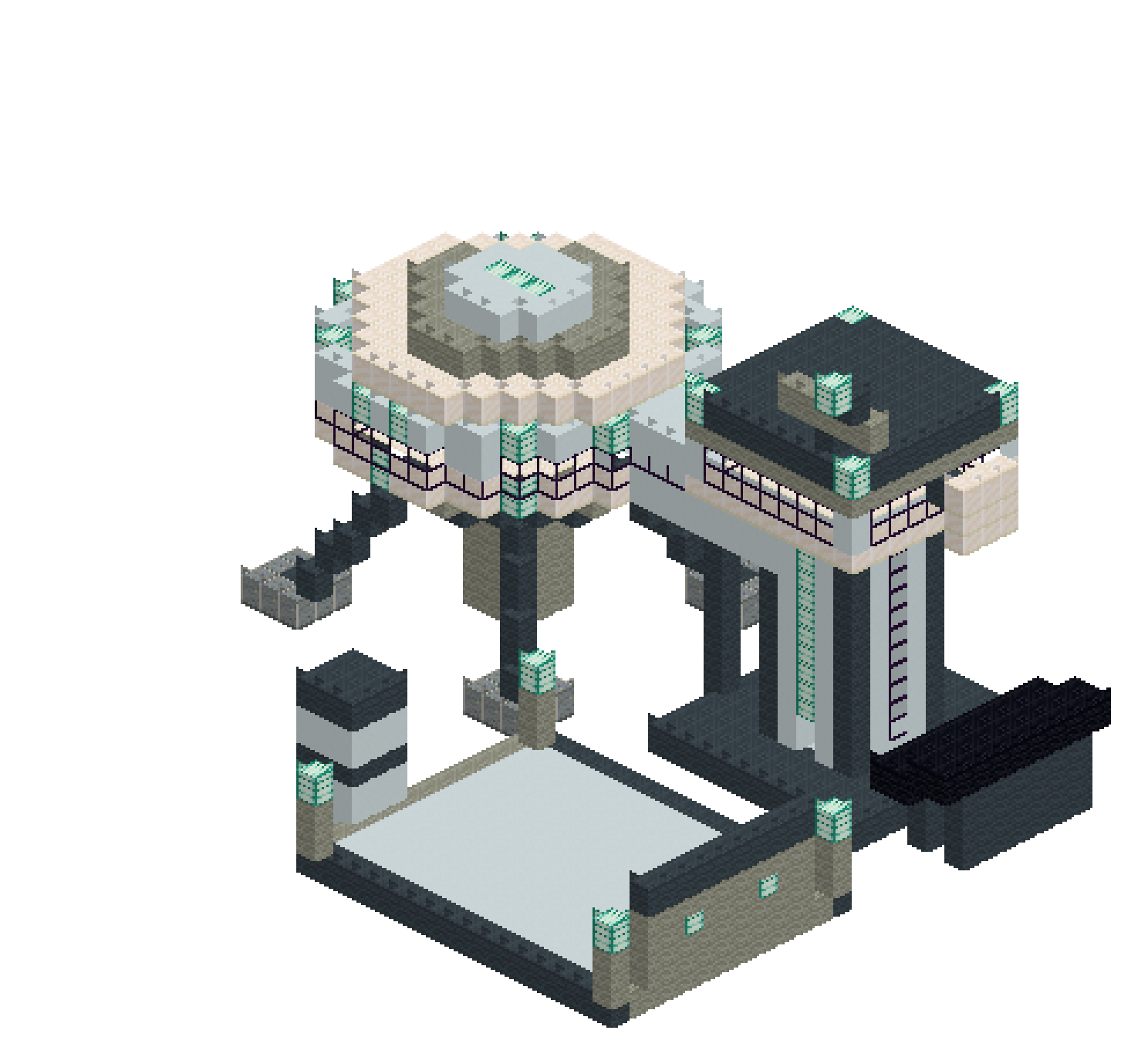
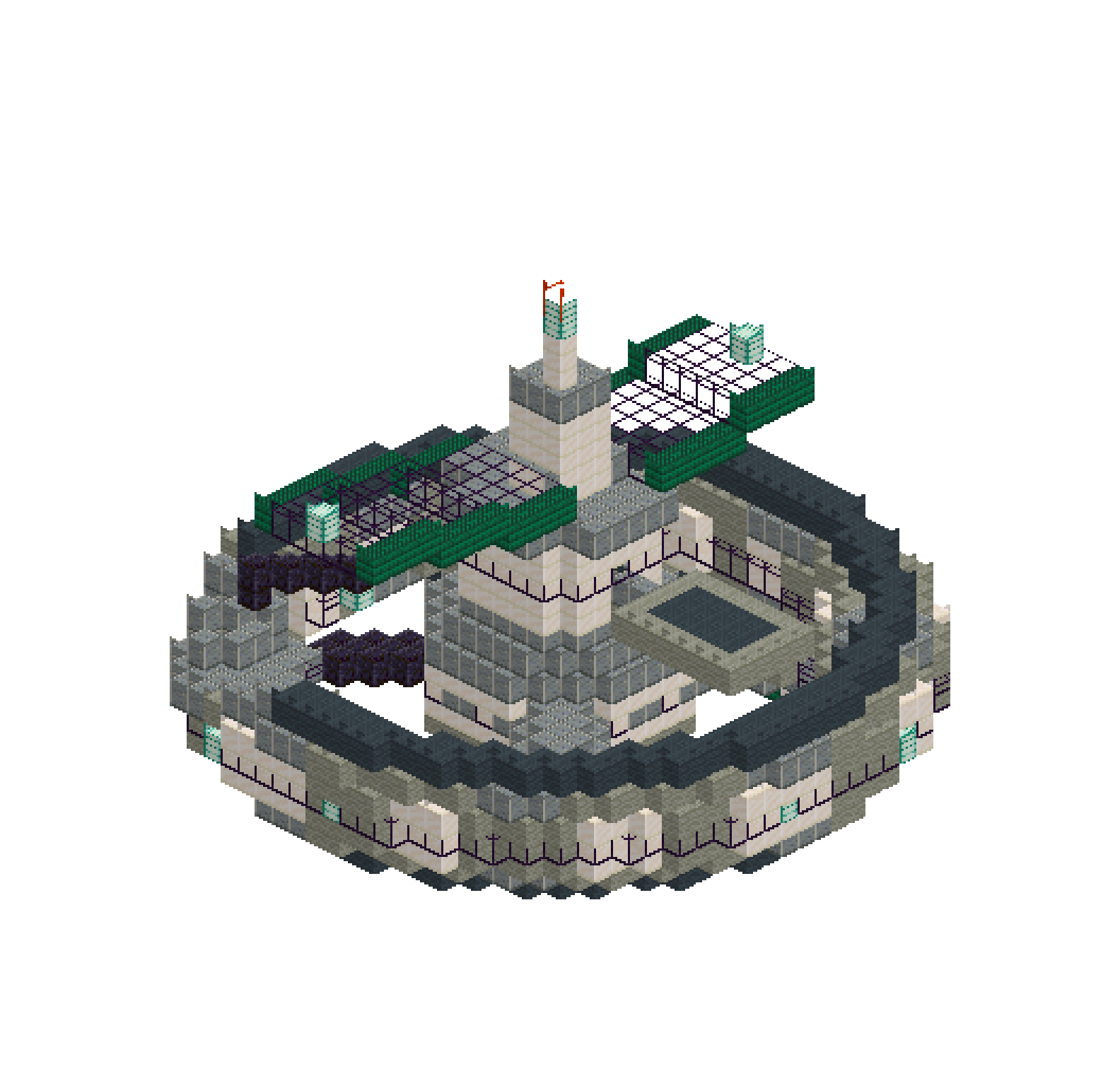
A ring thirty-one blocks across, carried on a single blackstone pylon. The torus is drawn as seven stacked cross-sections — a narrow keel, two widening courses of quartz and iron-grey wool, a belt of tinted glass at the equator, then the same three in reverse — and four spokes cross the void to a lit hub. A needle mast carries two stepped solar wings at unequal heights, a radiator fin juts the other way, and one arc of hull is deliberately left open: the plating steps down course by course into a bay of bare ribs, work lights and a gantry, with a shuttle parked on a docking boom underneath. That unfinished arc is the point. Without it, a perfect circle just sits there.
What you need
| Block | Count |
|---|---|
| Quartz block | 962 |
| Light gray wool | 898 |
| Polished andesite | 689 |
| Tinted glass | 321 |
| Gray wool | 268 |
| Polished blackstone | 175 |
| Blackstone | 61 |
| Dark prismarine | 60 |
| Sea lantern | 44 |
| Lightning rod | 1 |
Counts are exact for the model above. Mine a little spare — nobody places every block first time.
Building it
Each stage names the layers it covers. Drag the slider on the model to that layer and you are looking at exactly what the stage describes.
1.Pylon, dock and the parked shuttle
Three overlapping polished blackstone rectangles give the pad an octagonal outline, two smaller blackstone courses sit on top, and a sea lantern goes into each face. Four short diagonals climb from the pad corners to a 5x5 polished andesite column, and that column is the only thing touching the ground — everything above is cantilevered, which is the whole point of the pose. Two booms leave the column at y4: a stub east into a hollow docking collar lit top and bottom, and a longer one north carrying a small quartz shuttle with dark prismarine delta wings and a sea lantern exhaust.
2.The torus: courses five to eight
Seven stacked cross-sections make the tube, one layer each. Course 5 is a narrow grey keel ring, about radius 13 to 14. Course 6 widens to 12–15 in light grey wool with an andesite rib every third segment. Course 7 widens again and alternates quartz and light grey wool in fifteen-degree panels, so the hull reads as plating rather than a stripe. Course 8 is widest and carries the window belt: tinted glass on the inner and outer faces, sea lantern ports scattered along the outside. The four spokes are drawn on these same courses — three narrow ones, and a fat south-east trunk with a glowing sea lantern spine sleeved in tinted glass.
3.Closing the tube, opening the bay
Courses 9, 10 and 11 mirror 7, 6 and 5 and close the tube. Then take a bite out of it. Across roughly sixty degrees of arc the plating steps down one course at a time — full height at one end, bare deck at the other — and stops dead at a sheer edge, which is exactly how a hull under construction looks. Three andesite ribs stand in the open bay, their legs running down into the finished plating so they read as frames rather than posts, and a blackstone gantry with a hanging lantern leans out over the void. Two work lights sit on the deck. Resist finishing it: that missing arc is what stops a perfect circle reading as inert.
4.Collar, mast and radiator fin
An andesite collar at y12 crowns the hub, then a seven-wide octagonal quartz tower rises to y17 with a band of tinted glass ringed round it at y15 — lay the band solid, then put the quartz core back so only the perimeter stays glass. A wider andesite flange at y18 breaks the tower's height and gives the mast something to spring from. Off the east side a short truss carries a light grey and grey wool radiator fin, deliberately smaller than either solar wing so the three arrays never balance each other.
5.Wings, needle and beacon
The mast narrows to three wide, climbs to y23, caps with andesite, then runs on as a single quartz needle to a sea lantern and a lightning rod at y29. The wings hang off it at different heights and lengths: three stepped panels south, each four deep and rising a course as they go out, and only two north, starting a course lower. Every panel is a dark prismarine rectangle with a tinted glass inset, so the frame reads at distance and the cells read up close. A lantern at each tip finishes it.
Make it yours
- Lay the four spokes at course 8 first, then walk the outer rail from spoke to spoke — trying to place a 31-block circle freehand in mid-air is how rings end up egg-shaped.
- Tinted glass blocks light completely, so the window belt will not brighten anything. The glow you see is the sea lantern core in the hub and the lit spine of the main trunk spoke, so light those before you seal the tube.
- Quartz is expensive early on: diorite and calcite both stand in for it, and smooth stone reads close enough to light grey wool if you would rather not shear a whole flock.
- Set it where nothing sits behind it — a plateau edge, an ocean, a superflat — because the silhouette is the build, and a treeline behind the ring kills the read entirely.