How to build the Bunny Burrow in Minecraft
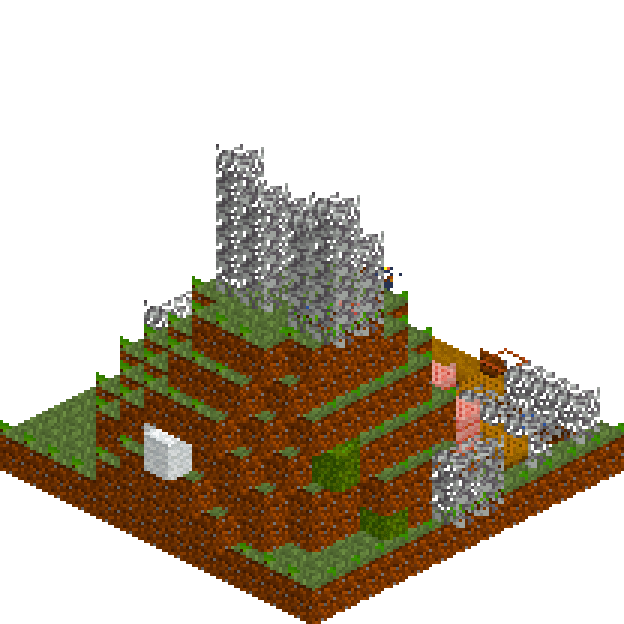
Half hillside, half front door. A rounded green mound with an arched cherry doorway cut straight into the bank, two leafy ears sprouting from the crown — one standing upright, one flopped forward over the front — and a carrot patch edged with slabs beside a path that wiggles rather than runs straight. It is six layer passes and four carving cuts, so the whole thing goes up in an evening, and every bit of the charm comes from the shapes rather than from rare blocks.
What you need
| Block | Count |
|---|---|
| Grass block | 267 |
| Oak leaves | 44 |
| Oak planks | 42 |
| Cherry planks | 15 |
| Dirt path | 14 |
| Gravel | 12 |
| Farmland | 8 |
| Water | 5 |
| Oak planks slab | 5 |
| Moss block | 5 |
| White wool | 5 |
| Lantern | 4 |
| Cherry planks slab | 3 |
| Bookshelf | 3 |
| Stripped oak log | 2 |
| Shroomlight | 2 |
| Hay block | 2 |
| Glass | 2 |
| Composter | 1 |
Counts are exact for the model above. Mine a little spare — nobody places every block first time.
Building it
Each stage names the layers it covers. Drag the slider on the model to that layer and you are looking at exactly what the stage describes.
1.Ground, path and carrot patch
One layer pass paints the entire plot at y=0. Grass everywhere, a two-block dirt path that wiggles across from x4 to x6 rather than running dead straight, a 2x2 pond in the front-left corner ringed with gravel for a shoreline, three rows of farmland along the front-right, and a rectangle of oak planks at x4-8, z4-9 which later turns out to be the burrow's floor. Laying that floor now saves carving around it afterwards, and it costs nothing extra because it rides along in the same op.
2.Six passes make the mound
Each layer op draws one horizontal slice of the hill, and every slice pulls in a block or two from the one below so nothing ever reads as a box. The base runs eleven wide through z5-8 and tapers to four blocks at the back; by y=6 the crown is down to five. The front face at z=4 stops at y=5 and stays steep on purpose, because it has to hold a door. Drop a few moss blocks into the y=1 and y=3 passes at the edges of the bulge to break up the flat green.
3.Carving the burrow and its round door
Order matters here: the mound goes up solid, then four clear ops take material back out. The room is x4-8, y1-3, z5-9, with a small domed ceiling scooped at y=4 above the middle three columns. The doorway pierces the single-block face at z=4, three wide through y1-3 and one wide at y=4, then cherry planks trace the arch around it: jambs at x3 and x7, shoulders at x4 and x6 on y=4, and a keystone at x5 on y=5. A cherry strip at x8 with one glass block set into it becomes a little lit porthole beside the door.
4.A warm room worth looking into
The point of a doorway this size is that people look through it, so the inside has to earn its keep. A white wool nest fills the back-right corner, hay stacks against the left wall, and two bookshelves line the back. Keep the light low: a shroomlight on the floor just inside the threshold, a lantern beside the nest, and one shroomlight hung in the apex of the domed ceiling where the block above holds it up. Warm light at ankle height spills out over the path and does more for the mood than anything on the outside.
5.Two ears, only one of them upright
Both ears are two blocks wide in oak leaves and both root into the crown, at x4-5 and x7-8, with a one-block gap at x6 between them. That is where the symmetry ends. The left ear stands straight up through five layers and narrows to a single pair at y=11. The right one leans a block forward on every layer, z7-8 then z6-7 then z5-6, and stops short at y=9 so it lops over the front-right shoulder of the mound. Two matching ears would have made this a model; one wonky ear makes it a face.
6.The bits that make it a place
A build like this loses half its charm sitting on bare grass. Slab edging pens in the carrot patch, three copper blocks with leafy tops stand as carrots half pulled from the soil, and a composter with copper heaped on top passes for a full basket. A stripped log with a lantern on it lights the path like a stumpy lamp post, a cherry slab bench faces the pond, lanterns flank the door at ground level, and leaf clumps at x0 and x12 soften the two open edges of the plot.
Make it yours
- Build the mound completely solid and carve afterwards — trying to leave a doorway-shaped hole while stacking layers always comes out crooked.
- If the door looks too small, take a block off the height of the front face rather than adding one to the opening; the arch should fill most of the bank.
- Copper block is the closest thing to carrot orange in the palette, and a single leaf block on top of it sells the idea instantly.
- Keep every light source at y=1 or up in the ceiling apex — light at eye level flattens the mound and kills the glow spilling through the door.
- Swap the cherry planks for crimson if your world is snowy; the pink reads warmer against grass, the crimson against white.