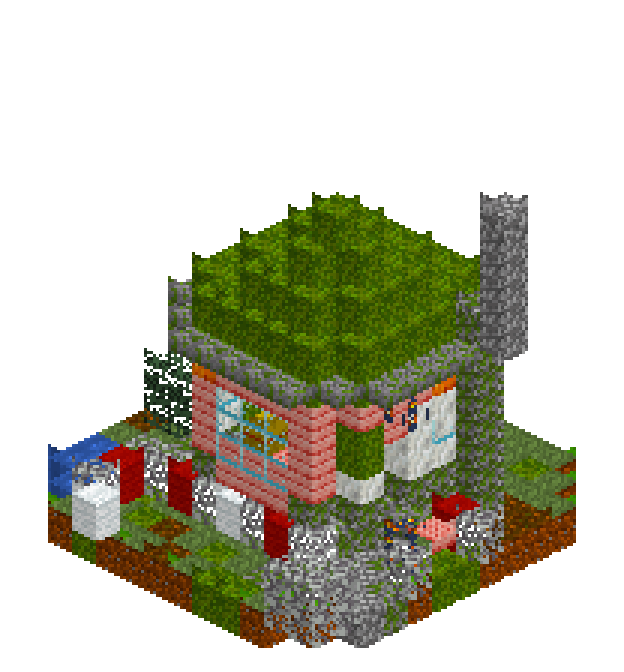
How to build the Seaside Beach Hut in Minecraft
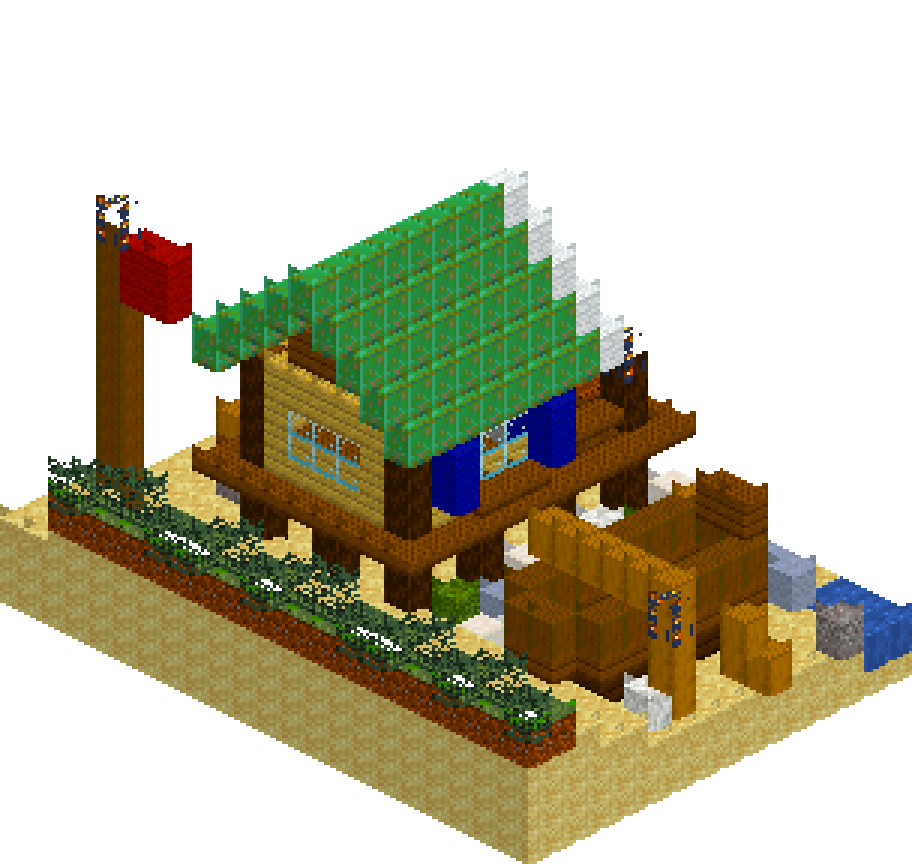
A little striped hut standing on spruce stilts over the sand, with a deck and a rail out front, a copper roof gone pale sea-green, and a rowboat run up on the shingle beside it. It is small enough to finish in an evening and detailed enough to carry a whole shoreline on its own: driftwood posts, shells and clay in the sand, marram grass on the dune behind. Every block is stock survival material — wool, birch, spruce and a little copper — so it drops straight onto a coastal base, a village beach or the edge of an ocean monument run.
What you need
| Block | Count |
|---|---|
| Sand | 868 |
| Spruce planks | 121 |
| Weathered copper | 72 |
| Spruce planks slab | 62 |
| Spruce log | 53 |
| Birch planks | 42 |
| Grass block | 40 |
| Dark oak planks | 32 |
| Stripped spruce log | 29 |
| Blue wool | 20 |
| Glass | 18 |
| Stripped oak log | 17 |
| Spruce leaves | 15 |
| White wool | 11 |
| Light gray wool | 8 |
| Water | 6 |
| Gravel | 6 |
| Clay | 6 |
| Calcite | 5 |
| Lantern | 5 |
| Red wool | 4 |
| Quartz block | 3 |
| Moss block | 3 |
| Composter | 1 |
| Crafting table | 1 |
Counts are exact for the model above. Mine a little spare — nobody places every block first time.
Building it
Each stage names the layers it covers. Drag the slider on the model to that layer and you are looking at exactly what the stage describes.
1.Beach, dune and driftwood
Two courses of sand across the whole plot, then step a dune up behind it: one course from z=11 back, a second from z=13 back, capped with grass on the last two rows. Stepping the dune rather than sloping it keeps the back edge readable from ground level. The scatter goes down as a single layer pass — gravel and clay for wet sand, calcite and quartz for shells, stripped oak for driftwood, moss for weed. Keep it sparse. A shell every few blocks reads as a beach; a shell every block reads as a gravel path.
2.Stilts, platform and the way up
Eleven spruce log posts three blocks tall, on a rough grid under the hut with a front row carrying the deck. Cap the lot with one plank plane at y=5, then ring it with a slab skirt sitting a block proud on every side. That overhang throws a shadow line under the floor and is the whole difference between a hut on legs and a shed on a box. The steps down are three plank stubs of falling height at x=4, 3 and 2, landing on a short slab path laid across the sand.
3.Walls and the striped front
Run the hut up as one solid birch mass, x=5 to 11 by z=4 to 10, four courses tall, then carve the inside out with a single clear. Faster than building four walls and the corners come out true. Spruce logs on all four corners give the frame its darker band. The front is painted afterwards: white wool across the whole panel, blue at x=6 and x=10, light grey at x=7 and x=9, leaving the centre column white for the door. Vertical stripes, never horizontal — that is what makes it read as a beach hut.
4.Glass, shutters and the deck rail
Three-wide glass on both side walls and a smaller pane at the back, each with a slab sill projecting one block out. Hang blue wool shutters either side of the side windows: two blocks of wool standing proud of the wall do more for the elevation than any pattern laid flat into it. The rail is a slab ring round the deck with the middle cleared out, spruce log newels on the two front corners and a lantern on each. Leave a one-block gap in the rail at the head of the steps.
5.The weathered copper gable
Give the roof a square 9x9 footprint, x=4 to 12 by z=3 to 11, so it overhangs the walls by a block on every side — that overhang is the eave and it needs no extra trim. Weathered copper carries a pale sea-green that sits between white wool and birch without shouting. Nine across rises four, so the ridge lands at y=14 and nothing pokes out of the plot. Then repaint the front face in white wool and carry the two blue stripes up from the wall, so the elevation reads as one striped front from sand to ridge.
6.Rowboat, mast and the last details
The boat is three horizontal slices: a dark oak bottom four wide with tapered ends, spruce sides as a ring above it, a stripped spruce gunwale on top, then a slab thwart across the middle and an oar laid over the rails. Drawn as layers it takes three passes; drawn as boxes it takes thirty. A driftwood mast planted in the dune with a red pennant and a lantern at y=15 gives the silhouette its high point, and a lantern on a driftwood post beside the boat gives the sand somewhere to glow after dark.
Make it yours
- Stripes only work vertically on a hut this small. A horizontal band squashes four courses of wall into a stripe of nothing, while vertical columns of white, blue and light grey make the front read taller than it is.
- The slab skirt at y=5 costs two ops and does most of the work. Without it the platform reads as a solid crate; with it the hut visibly floats on its legs and you get a shadow line under the deck.
- Keep the shell and driftwood scatter under roughly one block in eight. Past that the sand stops looking like sand and starts looking like a badly mixed path.
- Want corrugated tin instead of copper? Lay cut copper slabs as stepped courses over the same 9x9 footprint. Same ridge height, same eave, a completely different hut.
- Placing this on a real shore: sink the plot so the sand at y=0 meets the waterline, then let one corner flood. A tide pool with clay and moss around its rim sells the setting better than any amount of extra building.