How to build the Red Mushroom House in Minecraft
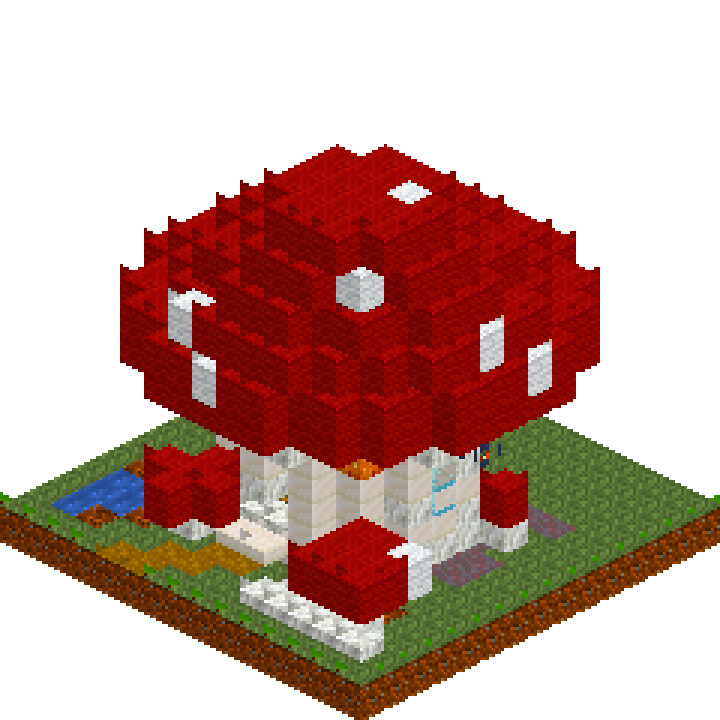
Every world has a mushroom field that nobody actually lives in. This fixes that. One giant toadstool: a pale quartz-and-calcite stem with a room hollowed out inside it, a domed red wool cap flaring out over the top like an umbrella, and a scatter of smaller mushrooms crowding the base. It goes up as flat circles, one layer at a time, so the intimidating dome turns out to be seven rings that each step in a single block. Best of all, the overhang buys you four blocks of covered porch on every side.
What you need
| Block | Count |
|---|---|
| Red wool | 497 |
| Grass block | 173 |
| Calcite | 166 |
| Quartz block | 37 |
| Mycelium | 28 |
| Oak planks | 21 |
| White wool | 19 |
| Coarse dirt | 11 |
| Dirt path | 8 |
| Glass | 8 |
| Shroomlight | 7 |
| Water | 5 |
| Lantern | 5 |
| Quartz block slab | 5 |
| Calcite slab | 5 |
| Moss block | 2 |
| Oak leaves | 2 |
| Crafting table | 1 |
| Bookshelf | 1 |
| Furnace | 1 |
Counts are exact for the model above. Mine a little spare — nobody places every block first time.
Building it
Each stage names the layers it covers. Drag the slider on the model to that layer and you are looking at exactly what the stage describes.
1.Ground, path and pond
Lay the whole 15x15 footprint as grass, then break it up straight away. Mycelium creeps out from where the stem will stand and fades to plain grass at the edges; that ragged transition is what stops the base reading as a model dropped on a lawn. A dirt path leaves the doorway at x6-7 and bends left as it goes, because a straight path looks like a corridor. A small pond fills the front-left corner with coarse dirt for a muddy shore, and a coarse-dirt bed front-right takes moss and two oak-leaf bushes at y1.
2.The quartz-and-calcite stem
The stem is a seven-wide circle: three blocks across at front and back, seven through the middle. Ring it in calcite at y1 as a plinth, floor the inside with oak planks, then run quartz up to y5 with calcite dropped in at random. The two whites read as one faintly mottled surface rather than a flat wall, which is exactly what a stalk should look like. Inside you get 21 blocks of floor and five of headroom: crafting table, bookshelf and furnace down the left wall, a red-and-white wool bunk on the right.
3.A round window and a bigger door
Carve after the wall is solid, never before. The doorway takes x6-7 at y2-3, plus one extra block pulled out at (7,4) so the arch is taller on one side. Off-centre by a single block is all it takes to stop the front looking machined. The left wall gets the big window: three glass at y3 and one at y4, a plus shape that reads as round from any distance. The right wall gets a mean little 1x2 slit instead, one glass block sits over the door as a transom, and two quartz slabs make a half-step up to the threshold.
4.The flared collar and white gills
This is where it stops being a tower. At y6, ring a nine-wide circle in calcite so it hangs one block clear of the stem all the way round and the stalk appears to swell outward. At y7, fill a solid eleven-wide disc, still calcite: that is the gill surface, and from inside it doubles as the ceiling. Drop shroomlight into the disc at four points around the rim and one over the middle of the floor, and the whole underside of the cap glows warm without a torch anywhere in sight.
5.The red cap, widest ring first
Widest first, always. Two full thirteen-wide discs of red wool at y8 and y9 give the cap its overhang, two blocks further out than the gills below, which is what makes the eaves feel sheltering rather than decorative. Then step in one block per side each course: eleven wide at y10, nine at y11, seven at y12, five at y13. That constant rate is why the profile curves instead of terracing. Scatter white wool spots as you go, but only on squares the layer above does not cover.
6.Toadstools, lanterns and trimmings
Four small mushrooms crowd the base and none of them match. The biggest, in the front-right bed, is a two-block calcite stem under a full 3x3 red cap at y3; a second stands back-left by the pond at the same height. Under the eaves a tiny one takes a single stalk with a five-block plus-shaped cap at y2, and the runt is one red block on one calcite stalk. Finish with a lantern on the ground either side of the path, two more hanging from the gills at y6, and a quartz sill under the big window.
Make it yours
- Build the cap from the widest ring downward in your head before you place it: if the thirteen-wide disc at y8 is a block out, every layer above inherits the error.
- Quartz and calcite look identical in a screenshot but not in daylight. Roughly one calcite in four is enough texture; much more and the stem starts to look damaged.
- Leave the ground under the overhang open. The cap shelters a ring of porch four blocks deep, and filling it in throws away the best part of the build.
- White spots only count where they show. Place them on squares the next layer up does not sit on, and keep them in twos so they read as blobs rather than pixels.
- A curving path sells a small build better than a straight one. Nudge it a block sideways every two rows so it wanders out of shot instead of pointing at the door.