How to build the Creeper Statue in Minecraft
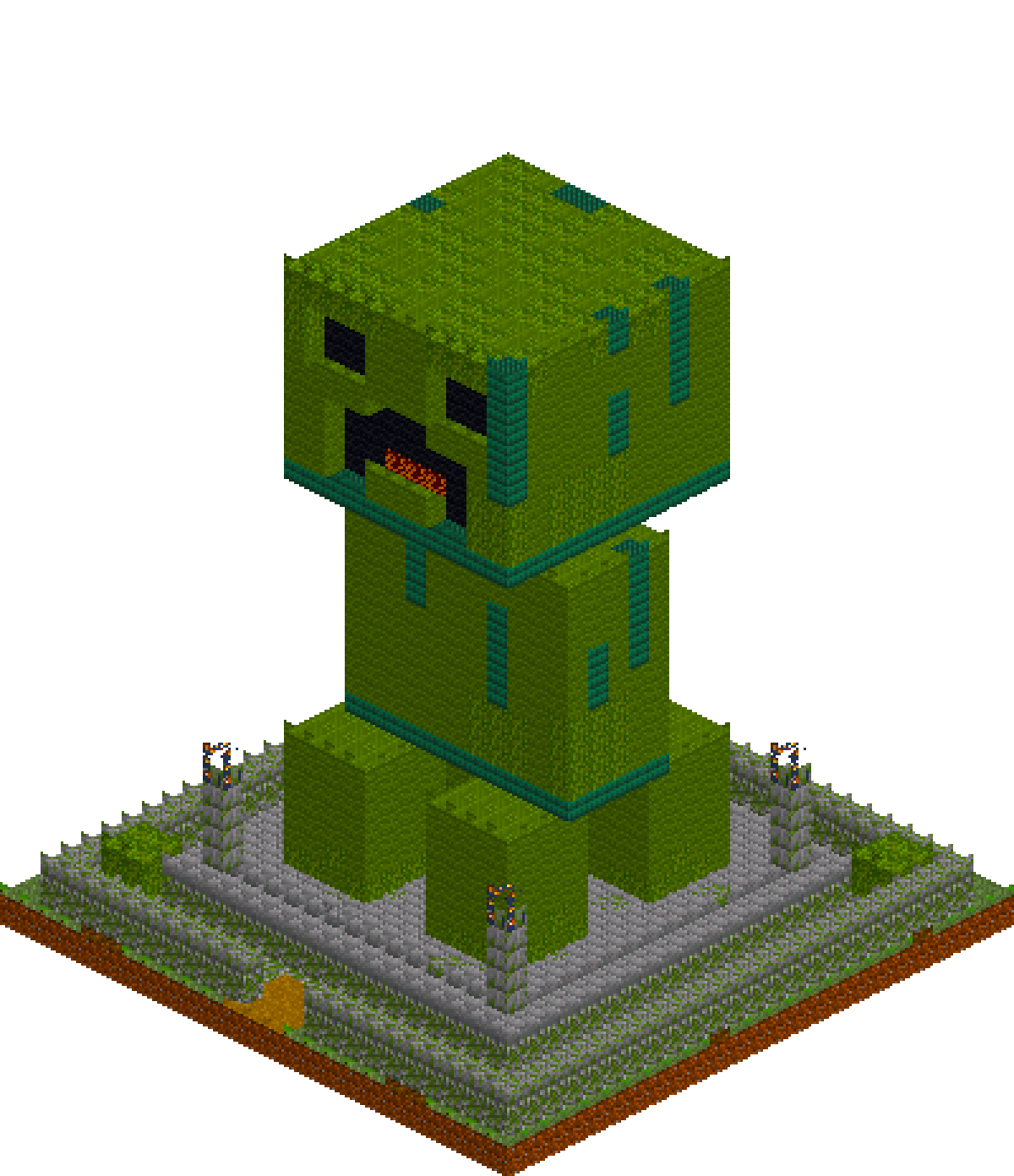
Nothing in the game is more recognisable at a distance, and nothing falls apart faster when it is built as one solid green lump. This one is set out on the mob's real proportions — stubby legs a fifth of the height, a body twice as wide as it is deep, a head the size of a small room — and then opened up where it counts. A cross of daylight runs under the belly between four separate feet, the head hangs clear of a pinched neck on every side, and the face is cut into the front and backed in black wool so the eyes and the frown stay dark at any hour. Green wool for the mass, dark prismarine for the damp, and a walled courtyard to keep it company.
What you need
| Block | Count |
|---|---|
| Green wool | 1680 |
| Mossy cobblestone | 796 |
| Dark prismarine | 280 |
| Moss block | 221 |
| Stone bricks | 173 |
| Cobblestone | 85 |
| Mossy stone bricks slab | 85 |
| Grass block | 78 |
| Stone bricks slab | 64 |
| Mossy stone bricks | 43 |
| Black wool | 43 |
| Cracked stone bricks | 25 |
| Gravel | 16 |
| Podzol | 15 |
| Dirt path | 9 |
| Lantern | 4 |
| Magma block | 3 |
Counts are exact for the model above. Mine a little spare — nobody places every block first time.
Building it
Each stage names the layers it covers. Drag the slider on the model to that layer and you are looking at exactly what the stage describes.
1.Ground, courtyard wall and plinth
Grass across the whole plot, then a mossy cobblestone apron inside a low wall — one course of mossy cobble round the perimeter, a mossy stone brick slab capping it, and a three-wide gap at the front where a dirt path comes through. The plinth is two courses: a 17x17 mossy cobble base at y=1, then a ring of stone brick slabs at y=2 with a 15x15 mossy stone brick top set inside them, so the rim chamfers instead of dropping straight. Mottle that top with plain, mossy and cracked bricks — it shows through the gaps between the legs, so it is worth the extra minute. A figure standing straight on turf always looks like it grew there; two courses of masonry make it look placed.
2.Four stubby legs, and the gaps between them
Four separate 4x4 columns, six blocks tall: x7-10 and x14-17, crossed with z7-10 and z14-17. That leaves a three-wide slot of open air running side to side and another running front to back, and those two slots crossing under the belly are the most important thing in the whole build. Place them, stand at ground level, and check you can see sky through both — if you cannot, the gap is too narrow, and silhouette lost here is never recovered higher up. Keep them stubby, a fifth of the total height at most; longer legs read as spider. Mottle the bottom two courses with moss block and dark prismarine, heaviest at the feet, so the statue looks damp where it meets the stone rather than snapped off at the ankle.
3.The body: wide, and deliberately thin
Eleven wide, eleven tall, and only five deep at z10-14. Thin is the point. A creeper's body is half the depth of its head, which means the legs already stand three blocks proud of it front and back, and the head will overhang it by the same again — so from any three-quarter view a deep recess runs across the front above the feet and another across the back. Band the bottom course in dark prismarine: that is the shadow the belly throws on itself, and it stops the body reading as a slab dropped on four posts. Then run one-block drips of dark prismarine down the two faces you can actually see, staggered at different heights, with moss block creeping up from the base to meet them.
4.Pinch the neck to seven by three
Two courses only, x9-15 by z11-13, in dark prismarine. Narrower than the eleven-by-five body beneath it and far narrower than the eleven-by-eleven head about to sit on it. This is not detailing — it is the reason the head will read as a head. Walk round at this height and you should see clean through the build on either side of the neck, because there is nothing there but air. Every statue that ends up looking like a boulder loses it exactly here, by carrying the full body width straight on up into the skull. Two courses of almost nothing, and they do more work than the other thirty put together.
5.Set the head on and keep the undercut
An eleven by eleven by ten block from y=22 to y=31, x7-17 and z7-17. It overhangs the neck by two blocks each side and four front and back, and it is supposed to: that floating lip is the jaw, and the shadow beneath it is what separates head from body at fifty blocks away. Make the entire bottom course dark prismarine so the underside and the chin line read as one continuous shadow. Weather it downwards from the crown — a mottled cap of moss block and dark prismarine at y=31, then single-block drips running down the corners and the side faces out of it. Leave the front plane clean; it is about to become the face.
6.Cut the face, and back it in black
Work the front plane at z=17 as a grid, top down. One blank course at y=31, then the eyes at y28-30 as two three-by-three squares on x8-10 and x14-16. Under the gap between them, a three-wide notch at y=27 on x11-13; then the mouth proper at y24-26 across x9-15; then the two prongs at y=23 on x9-10 and x14-15, with three green blocks left standing between them. That bottom row is what makes it a creeper rather than a smiling frog, so do not skip it. Clear every shape exactly one block deep and back it with black wool at z=16 — one, not two, because from a three-quarter view a deeper reveal swallows the socket and the eyes shrink to slits. Three magma blocks at the back of the throat give it a lit fuse after dark.
Make it yours
- Draw the face grid on paper before you place a block. One blank course, three of eye, one notch, three of mouth and one of prong comes to exactly ten, and if the head is not exactly ten tall the frown lands off-centre and no amount of moss will rescue it.
- Swap the black wool behind the eyes for tinted glass over sea lanterns and the sockets stay black by day but stare back at night, without changing the silhouette by a single block.
- Green wool and moss block are nearly the same tone in daylight, so moss on its own will not read as weathering from any distance. Dark prismarine is the one genuinely darker green in the palette — use it for every streak you actually want seen.
- Scale it by adding courses to the body and nothing else. Leg height is fixed by how stubby a creeper reads, head height is fixed by the ten-row face grid, and stretching either one turns it into a different mob.
- Sink the plinth into a slope and let the courtyard wall retain the high side. A statue looks placed when the ground has been worked around it, and parachuted in when it has not.