How to build the Winged Sentinel in Minecraft
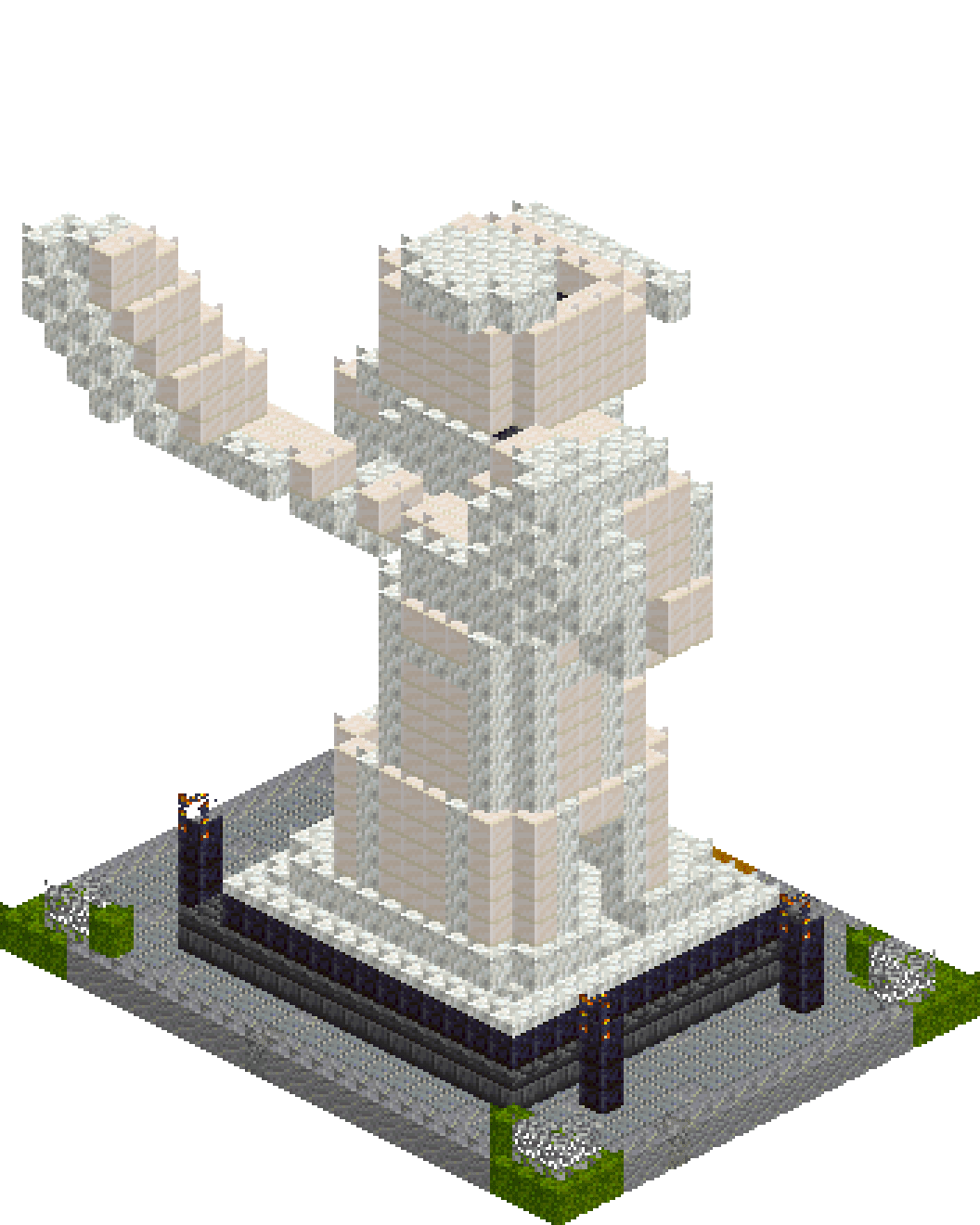
Most Minecraft statues fail for one reason — they are solid, and a silhouette with no holes in it reads as a rock. The Winged Sentinel is built the other way round, from its gaps. Daylight runs straight through the robe at hem level, a column of air separates each folded arm from the ribs, the neck is three blocks of dark basalt beneath a hood that overhangs it on all four sides, and both wings stand two clear blocks behind the shoulders instead of growing out of them. Quartz and calcite on a black plinth, hollow enough to walk inside, lit from within.
What you need
| Block | Count |
|---|---|
| Calcite | 588 |
| Quartz block | 481 |
| Polished andesite | 340 |
| Deepslate bricks | 210 |
| Polished blackstone | 169 |
| Andesite | 86 |
| Calcite slab | 53 |
| Moss block | 40 |
| Smooth basalt | 18 |
| Oak leaves | 12 |
| Dirt path | 10 |
| Chiselled stone bricks | 7 |
| Lantern | 4 |
| Sea lantern | 4 |
| Gravel | 3 |
| Shroomlight | 2 |
Counts are exact for the model above. Mine a little spare — nobody places every block first time.
Building it
Each stage names the layers it covers. Drag the slider on the model to that layer and you are looking at exactly what the stage describes.
1.Plaza, plinth and four black posts
Lay the ground first so the figure has somewhere to stand: polished andesite inside a plain andesite verge, worn patches and gravel grit scattered through it, moss at the four corners and a short dirt path entering at the front. The plinth is three tiers, each inset a block — deepslate bricks, then polished blackstone carrying a seven-wide band of chiselled stone bricks across its front face, then a calcite top with a calcite slab course left showing as a one-block border. Dark base, pale cap: the statue will read white because the thing beneath it is black. Four blackstone posts at x=3 and x=21 frame the plinth and will take the lanterns.
2.Flared hem and the hollow robe
Layer 4 is a two-block-thick ring, eleven wide, sitting on the calcite cap and overhanging every course above it. That hem flare and the shadow under it do more than any carved detail could. Above it the robe is a one-block shell — nine wide to y=9, seven from y=10 — so the taper reads as cloth rather than a pipe. Leave calcite at x=10 and x=14 and along z=7 and z=10 and those ribs run the full height as vertical folds. Now cut the side slits: x=7-8 and x=16-17 at z=8-9, five blocks tall, both sides. You can see straight through the statue and walk in. Close the section with a solid calcite belt at y=15.
3.Folded arms and the gap that sells them
This is the most important air in the build. The torso holds x=9-15. The sleeves sit outside it at x=6-7 and x=17-18, flaring to x=5 and x=19 at the elbows on y=18-19. Column x=8 and column x=16 stay empty from y=17 to y=22 — six blocks of daylight between each arm and the ribs, open at the bottom so light falls right through. Do not fill them, however wrong they look while you are standing next to the build. The forearms cross the chest at y=18-19 on z=5, one block proud of it, stepping out again to z=4 at y=19, with pale quartz at each end for the hands. Head-on they bridge the gaps; from the side the gaps are still wide open.
4.Shoulders, and a neck built too thin
Y=23 and y=24 are the only genuinely solid layers in the figure: a shoulder slab thirteen wide at 23, sloping in to eleven at 24, capping the sleeves and closing the arm gaps from above. Then everything stops. The neck is three by three, x=11-13 and z=7-9, in smooth basalt — dark deliberately, because a pale neck welds the head to the chest and kills the whole figure. Two layers only. Step back forty blocks and you should see a broad white shoulder line, a thin dark stem, and nothing else at that height. If the stem is not obviously narrower than both the mass below and the mass above, it is wrong.
5.The hood, its brim, and two lit eyes
Build the hood as a hollow seven-by-seven shell so it overhangs the neck by two blocks front and back and three each side. That undercut is the shadow beneath the jaw and it is what turns a box into a head. The face is the front row at z=5: polished blackstone across y=27, then at y=28 blackstone with sea lanterns at x=11 and x=13. Y=29 pushes a calcite brim forward to z=4, one block proud and one wider than the face, hanging directly over the eyes. Then pull back — y=30 starts at z=6, y=31 is a small calcite cowl at z=8-11. Forward at the bottom, back at the top: that is a bowed head, and no other trick is needed.
6.Wings, standing clear of the back
Hide the root. It runs x=13-15 at z=11-12 on y=20-22, tucked behind the shoulder blades and narrower than the torso, so nothing protrudes at arm height. From y=23 the wings leap outward and every block sits at z=13 or further back, while the body ends at z=10 — two full blocks of air between wing and shoulder at every level, and that gap is visible from every angle but dead ahead. They climb to x=19-23 by y=25 and finish in the far corner at x=21-23, z=16-18: up, and back. Calcite on the outer two columns and the trailing edge, quartz inside. Above y=24 skip every other block along the trailing edge so the feathers end ragged rather than sawn.
7.Light, and the shrine inside the robe
Four lanterns cap the posts at y=4, and four lamps go on the chamber floor — sea lanterns at z=7 and z=10, shroomlights either side of them. The robe is hollow from the plinth to the shoulders, nineteen blocks of headroom, and its only openings are the two side slits and a one-block cleft up the front at x=12 from y=4 to y=9. At night the slits and that cleft glow, so the Sentinel looks lit from inside rather than floodlit from outside, which is the difference between a monument and a lamp post. Oak leaves on the plaza corners at y=1 keep the andesite from reading as a car park.
Make it yours
- Drop to ground level and walk forty blocks out after every layer above y=17. A figure is judged in silhouette, and the only way to know a gap has quietly closed is to look at it with sky behind it.
- If the head looks wrong, the neck is almost certainly too wide. Three blocks is right under a seven-wide hood; four already reads as shoulder and the head stops being a head.
- Calcite and quartz sit close enough in tone to band without shouting. Keep calcite for edges, fold ribs and feather tips, quartz for flat faces, and the statue gains depth without gaining colour.
- Build one wing only, then mirror it by hand with x mapped to 24 minus x. Working both at once, level by level, all but guarantees they finish at different heights and different sweeps.
- Sea lanterns for the eyes rather than glowstone or shroomlight: cooler, dimmer, and they do not wash out the blackstone around them, so the face stays a face instead of becoming a lamp.