How to build the Iron Golem Statue in Minecraft
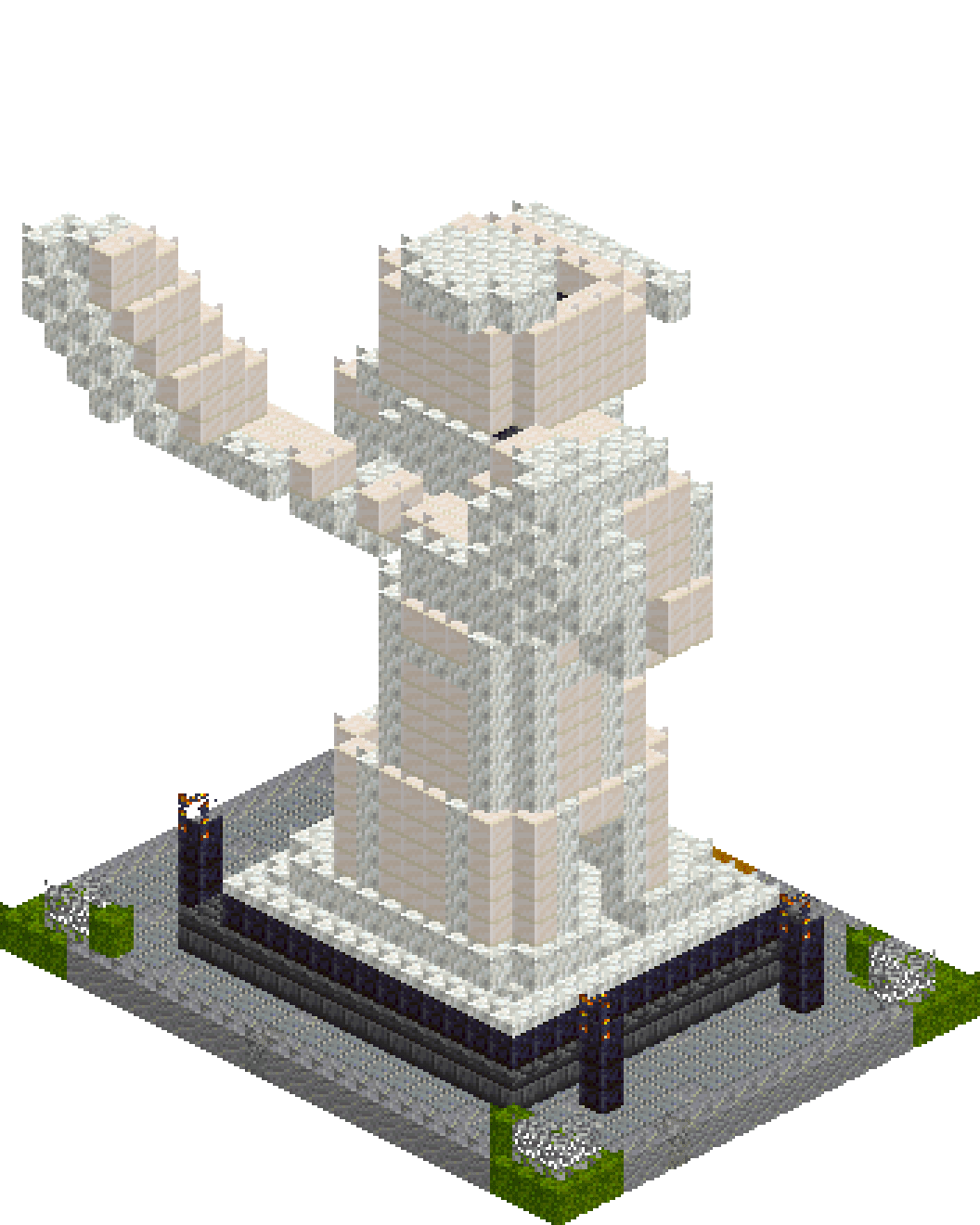
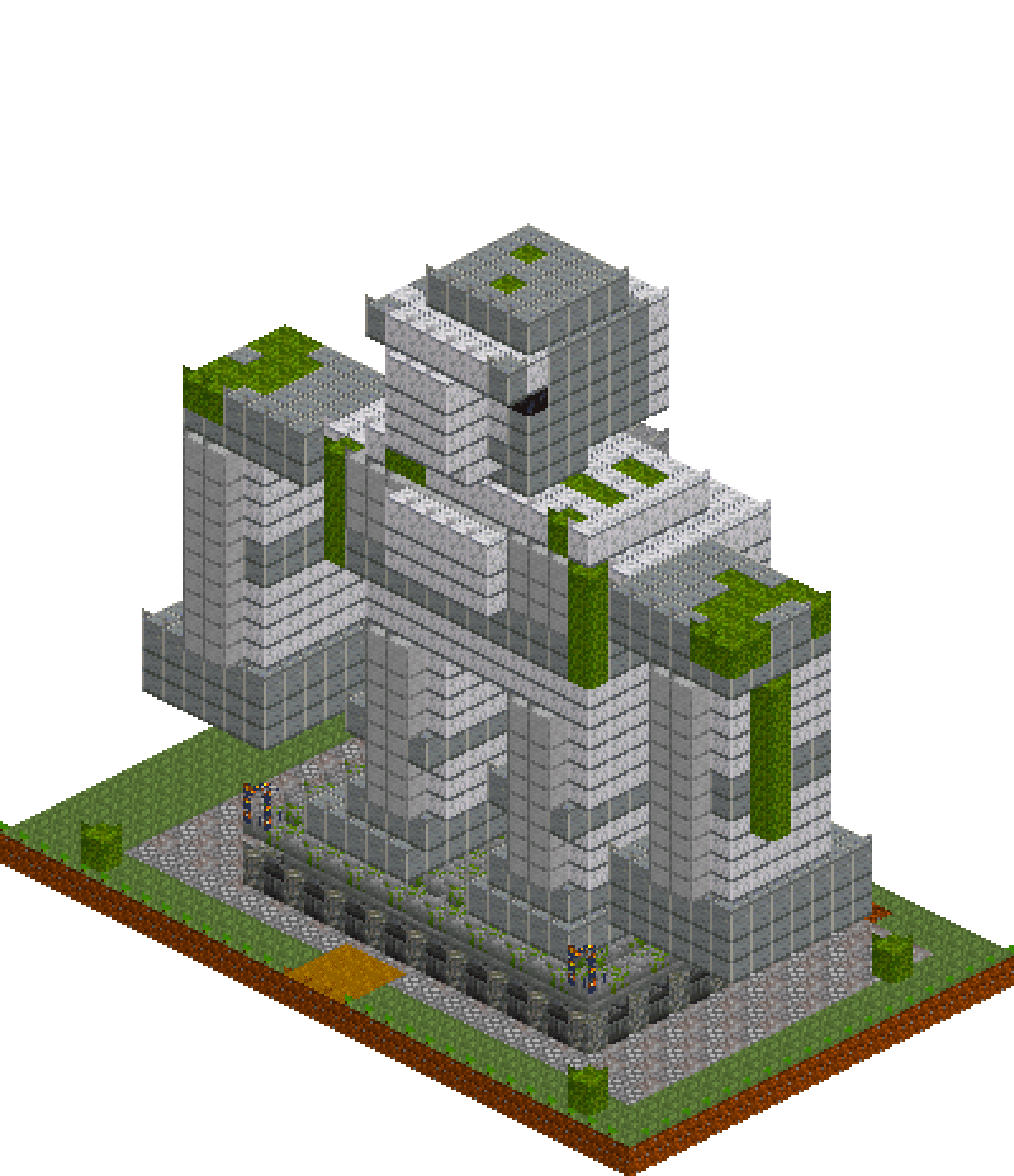
A village guardian standing 28 blocks from sole to crown on a mossy stone plinth, lanterns burning at its feet. What makes a golem read as a golem is not the iron, it is the air around it: three columns of daylight between the legs, two between each arm and the ribs, and a three-wide neck with nothing beside it so the head sits clear of those enormous shoulders. Polished diorite carries the pale plate, polished andesite the joints and the fists, and moss has taken both shoulders the way it takes anything left standing in a village long enough. Two shroomlights burn in a blackstone band under a projecting brow, and that is the moment the thing stops being a tower and starts being a face.
What you need
| Block | Count |
|---|---|
| Polished diorite | 1452 |
| Polished andesite | 949 |
| Grass block | 206 |
| Gravel | 188 |
| Cobblestone | 184 |
| Stone bricks | 132 |
| Smooth stone | 105 |
| Tuff | 94 |
| Deepslate bricks | 93 |
| Mossy stone bricks | 68 |
| Cracked stone bricks | 67 |
| Moss block | 64 |
| Stone bricks slab | 26 |
| Mossy stone bricks slab | 26 |
| Andesite | 15 |
| Mossy cobblestone | 13 |
| Cobblestone slab | 13 |
| Dirt path | 9 |
| Blackstone | 5 |
| Lantern | 4 |
| Chiselled stone bricks | 3 |
| Coarse dirt | 2 |
| Shroomlight | 2 |
Counts are exact for the model above. Mine a little spare — nobody places every block first time.
Building it
Each stage names the layers it covers. Drag the slider on the model to that layer and you are looking at exactly what the stage describes.
1.The yard and the plinth
Ground first: grass over the whole plot, a gravel-and-cobble yard through the middle of it, and a three-wide dirt path running in from the front so the statue has an approach rather than just a location. The plinth is three courses and each does a different job. The bottom course is deepslate brick mottled with tuff — dark, damp foundation stone, and the reason the pale figure above never bleeds into the ground. The second steps in one block, is stone brick and cracked stone brick, and carries three chiselled blocks as a plaque on the front face. The third steps back out as a slab cornice with a solid top, so the base reads as base, die and cap instead of a stack.
2.Feet, legs, and the gap between them
The feet are polished andesite, five wide and eight deep, sitting two blocks proud of the shins at the toe — a golem is front-heavy and the feet should say so. Above them the legs are four wide and six deep in polished diorite, at x 11-14 and x 18-21. That leaves three columns of pure daylight between them, unbroken from the ankle to the hips ten courses up. Do not close it. That gap is the single thing separating a standing figure from a plinth with a lump on it, and it is the first thing every failed statue gets wrong. A two-wide smooth stone ridge runs up the front of each shin, and a band of polished andesite at knee height splits the leg into thigh and calf.
3.Hips, waist flange and chest
Hips first, eleven wide, closing the leg gap. Then a waist flange in polished andesite that oversails the hips by a block on every side — that overhang is what gives the torso a belt line and a shadow. The chest is fifteen wide against those eleven-wide hips and is built in three planes: the mass at the back, a smooth stone breastplate one block proud, and a five-wide diorite panel proud again. Three steps of relief with almost no colour change, so it sculpts rather than patches; a dark panel here reads as a hole. A strip of andesite runs up the spine at the back. Finish with a trapezius course eleven wide, stepping in ready for the neck.
4.Arms hung clear, fists at the shin
The arms are four wide and five deep and hang outside the body entirely, at x 3-6 and x 26-29 with the chest at x 9-23. Two columns of air sit between each arm and the ribs and stay open for ten courses — look straight through them from ground level before you go any higher. Nothing bridges that gap until the deltoids at y 20-21, and those are polished andesite so they read as separate mass from the pale chest and give the shoulder a slope rather than a lintel. The fists are six wide, three tall, and stop at y 7 level with the shins, because golem arms are absurdly long and that is the whole character. A smooth stone ridge runs down the front of each arm.
5.Neck, jaw and the face
The neck is three by three and two tall, standing on an eleven-wide trapezius with air on all four sides — that void is the trick, and it only works if nothing else occupies those two layers. The jaw above is five by five so it overhangs the neck by a block; the head above that is seven by seven so it overhangs the jaw again. Two stacked undercuts, and the head reads as a head instead of a continuation of the body. The nose hangs five courses down the centre of the face and projects two blocks clear of it. Eyes are shroomlight set into a blackstone band, with a heavy brow oversailing them by one so they sit in permanent shadow. Cap it with a crown course inset all round.
6.Moss, ivy and the lamps
Moss block does the growth here rather than leaves, because moss reads green from across a valley and leaf blocks render grey. Patch it across both deltoids and along the top of the chest, then run four strands down: one on the outer face of each arm, one down each side of the breastplate. Four lanterns sit on the plinth cornice at the corners of the cap, low enough to uplight the feet and the underside of those hanging fists. Finish the plot with a low mossy cobble wall behind, a slab coping along it, and a couple of moss mounds out on the grass to break the edge of the yard.
Make it yours
- Build one leg completely, then count across and mirror it block for block. A golem whose legs differ by one reads as a limp from fifty blocks away, and it is far harder to spot once the torso is sitting on top of them.
- If the figure looks like a gateway, the fault is the shoulders. Cut the top course back over each arm so the chest tops out higher than the deltoids do, and the lintel read disappears immediately.
- Stand at ground level directly in front of it before you place the head. If you cannot see sky through the leg gap and through both armpits, widen each by one block before you build another course.
- Swap the shroomlight eyes for froglight if you want a colder stare, but keep the blackstone band around them — the dark surround is doing more work than the light is.
- Keep the plinth darker than the figure. Deepslate brick under stone brick is enough of a step; build the base in the same pale stone and the golem sinks straight into it.