How to build the Guardian Wolf Statue in Minecraft
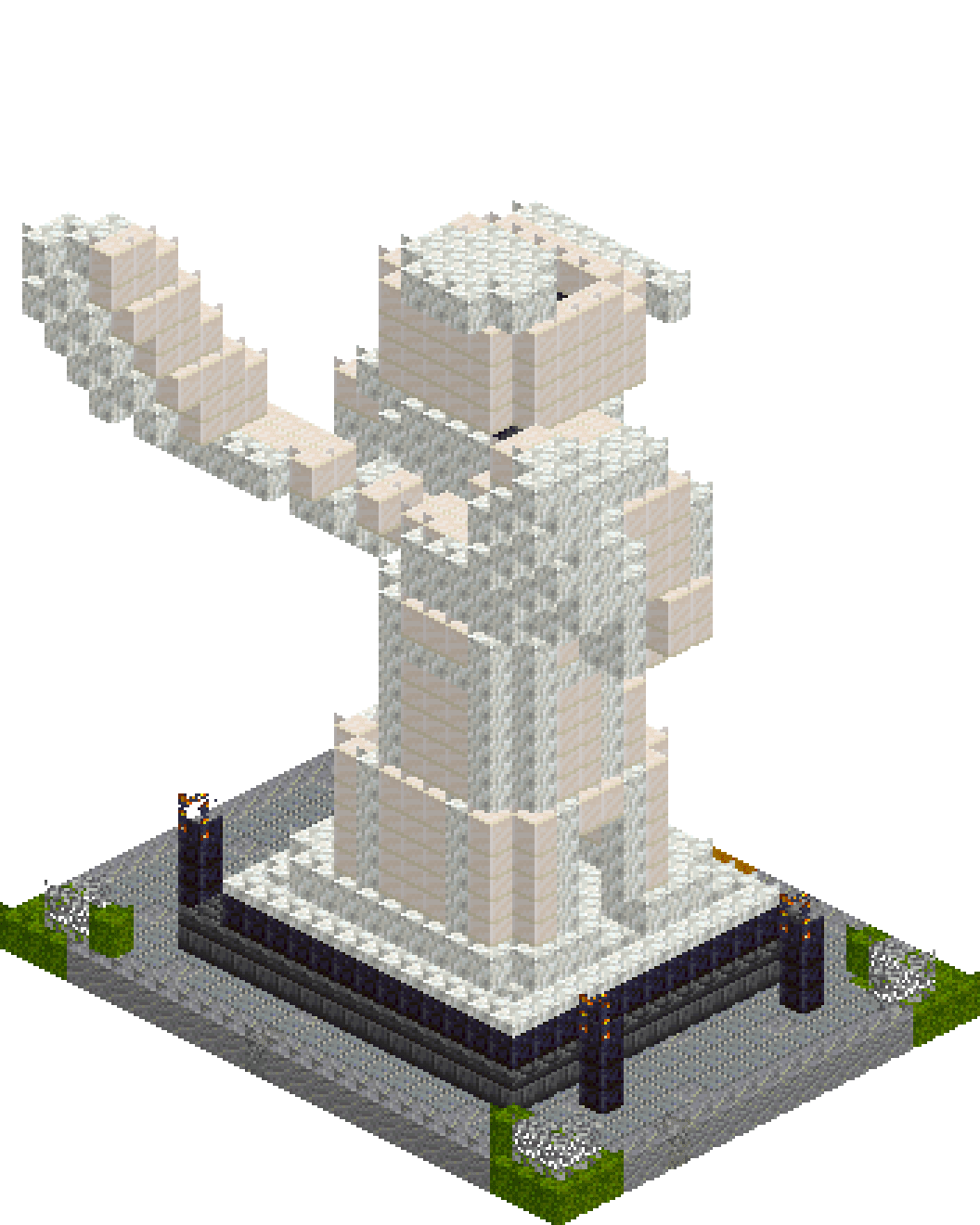
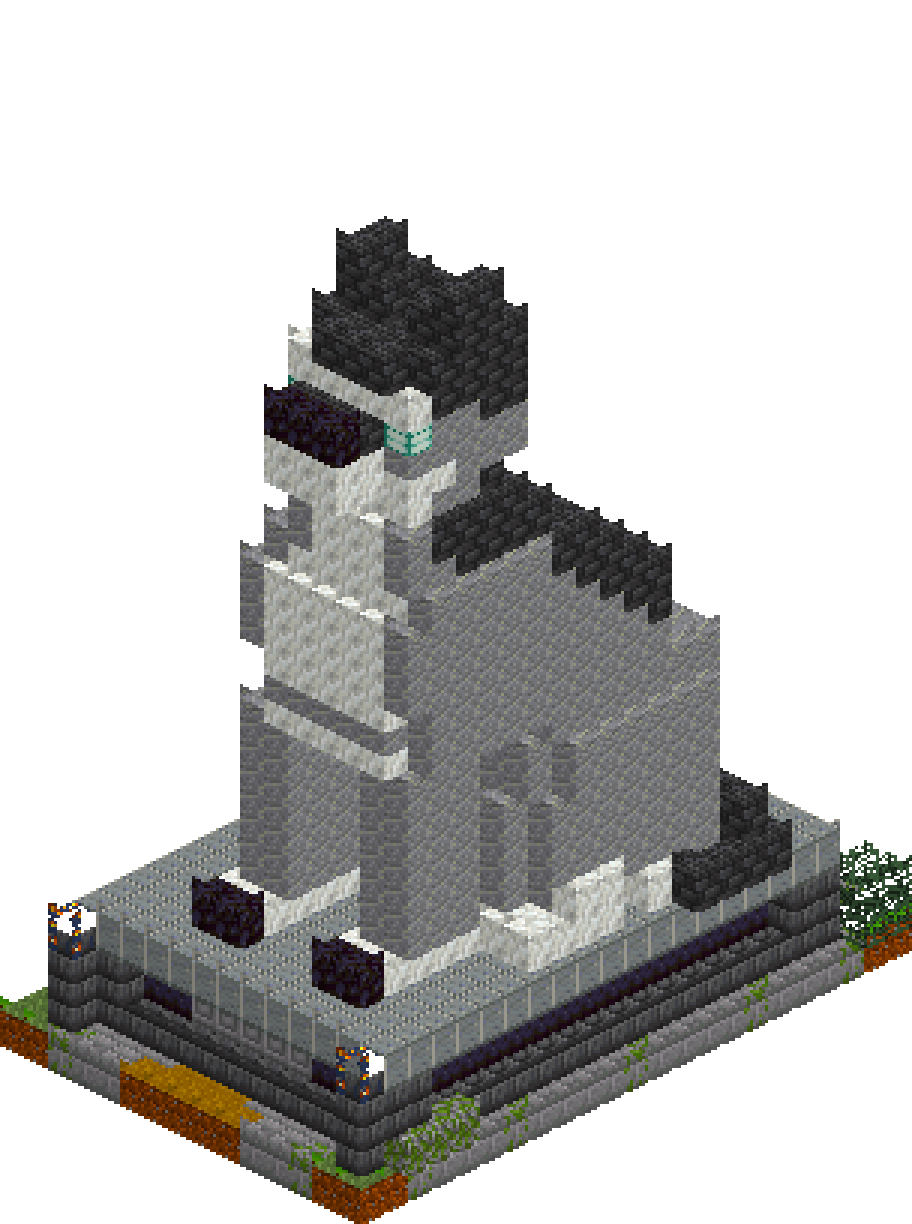
A sitting wolf is the statue most likely to go wrong: fill the space under the chest and it slumps into a boulder, and no amount of detail on the face will rescue it. This one is cut in three stone tones — andesite for the coat, calcite for the chest blaze, muzzle and paws, deepslate tiles for the mantle running from rump to ear tips — and it is built around its holes. Daylight passes right through behind the elbows, the front legs stand clear of one another, the head hangs three blocks out over open air, and two sea lanterns burn either side of the muzzle. Twenty-six blocks over a plinth, it makes a proper landmark for a spawn gate or the head of a road.
What you need
| Block | Count |
|---|---|
| Andesite | 1101 |
| Polished blackstone bricks | 356 |
| Stone bricks | 306 |
| Deepslate bricks | 285 |
| Polished andesite | 247 |
| Deepslate tiles | 197 |
| Calcite | 127 |
| Mossy stone bricks | 19 |
| Spruce leaves | 16 |
| Grass block | 12 |
| Chiselled stone bricks | 10 |
| Dirt path | 8 |
| Blackstone | 7 |
| Mossy cobblestone | 6 |
| Lantern | 2 |
| Sea lantern | 2 |
Counts are exact for the model above. Mine a little spare — nobody places every block first time.
Building it
Each stage names the layers it covers. Drag the slider on the model to that layer and you are looking at exactly what the stage describes.
1.Plinth, paving and lanterns
Lay the courtyard at y=0 — stone bricks, mossy ones scattered along the visible edges, and a dirt path arriving at the front centre. The plinth is three moves: a deepslate brick base course at y=1 spanning x1-13 by z2-20, a body at y=2-3 inset one block all round, and a polished andesite cap at y=4 back out flush. That inset is the trick — it cuts a continuous shadow line under the cap and above the base, and a stack of blocks becomes architecture. Bring the four corners back out as 2x2 deepslate pilasters, sink a chiselled stone brick panel into the recessed front face for an inscription, and stand a lantern on a short post at each front corner so the face is lit from below at night.
2.Paws, tail and folded haunches
Only y=5 touches the plinth. The front paws are two 2x5 pads at x4-5 and x9-10 running z14-18, tipped with blackstone claws; the rear feet are pale pads at x2-3 and x11-12, z10-13; the tail hooks out at x12-13 and back in, leaving a one-block window you can see through. The haunch above is an oval — x3-11 through the middle, chamfered to x4-10 front and back — and it stops dead at z=12. Everything else here is negative space. The legs are two 2x3 columns rising to y=12 with three empty columns (x6-8) between them, and z=13 stays completely empty from y=6 to y=12: a seven-tall slot of open sky between the folded haunch and the back of the elbow. That slot is what separates a sitting wolf from a rock.
3.Brisket, barrel and sloping back
The belly bridges at y=13, running z11-16 to close the top of the elbow slot and tie the haunch to the legs — pale calcite underneath, because the underside of a wolf is light and the eye reads that as depth. From here the back line steps back exactly one row per level: y=15 begins at z=5, y=16 at z=6, and so on to y=19 at z=9. That single rule drops the rump away behind and leaves the withers standing high at the front, which is the entire posture. Lay deepslate tiles on the top two rows of each level and the dark mantle rolls over the spine on its own. Keep the chest face at z=16 with a calcite blaze up its centre.
4.Shoulders, and a neck that is thinner
Pull in to five wide (x5-9) at y=20-21, then cut the neck to three wide and four deep: x6-8, z11-14, two levels only. It must be narrower than the five-wide shoulder beneath it and narrower than the five-wide skull that lands on it — that double step is the only thing that says neck rather than tube. Dark deepslate on the nape at z=11 carries the mantle up; calcite at z=14 is the throat. Leave z15-17 empty across both levels. That is the air the jaw is about to hang over, and filling it is the most common way this build dies.
5.Skull, muzzle and lantern eyes
The skull is x5-9 by z11-15 and it deliberately overhangs the neck on both sides and at the front. The muzzle is narrower still — x6-8, z16-17 — and exists for three levels only, y=24-26, so it projects from the lower half of the head with clear air above it and a hard undercut below. Calcite underneath for the jaw and lower muzzle, a dark deepslate bridge on top, a blackstone nose along the front top edge. Set the two sea lanterns on the front plane at z=15, x=5 and x=9, level with the top of the muzzle and flanking it, with the dark bridge between them and a calcite brow band directly above at y=27. Pale brow, dark mask, glowing eye: three moves and it has a face.
6.Ears, and the walk-around
Two 2x2 ears at x5-6 and x8-9, z12-13, with x=7 left empty between them — pricked ears that touch read as a helmet, not a wolf. At y=30 keep only the outer column of each so the tips lean away from one another. Then walk round it. From three-quarters you should see sky through the elbow slot, the shoulder standing proud of the narrower neck, and a hard shadow under the jaw. If the silhouette has gone solid anywhere, the fix is always subtraction: take a block out, never add one.
Make it yours
- Build one flank, then count to the centre column at x=7 and mirror it block for block — a one-block drift in the haunches twists the whole pose and stays invisible until you step back.
- Everything here comes out of the first hour underground: andesite, calcite and deepslate tiles are all common above y=0. Swap deepslate tiles for blackstone if you want a darker, more ominous mantle.
- Sea lantern eyes wash out at midday. Shroomlight gives an angrier orange stare and amethyst block reads as an ice wolf — whichever you pick, keep it to exactly two blocks.
- Scaling up? Add levels to the legs and one to the neck before you touch the head. Enlarging the skull is the fastest route to something that looks like a bear.
- The chest blaze and pale belly are not decoration — a light underside against a dark spine is how real animals read at distance, and it does more for the shape than any extra detail.