How to build the Warden Statue in Minecraft
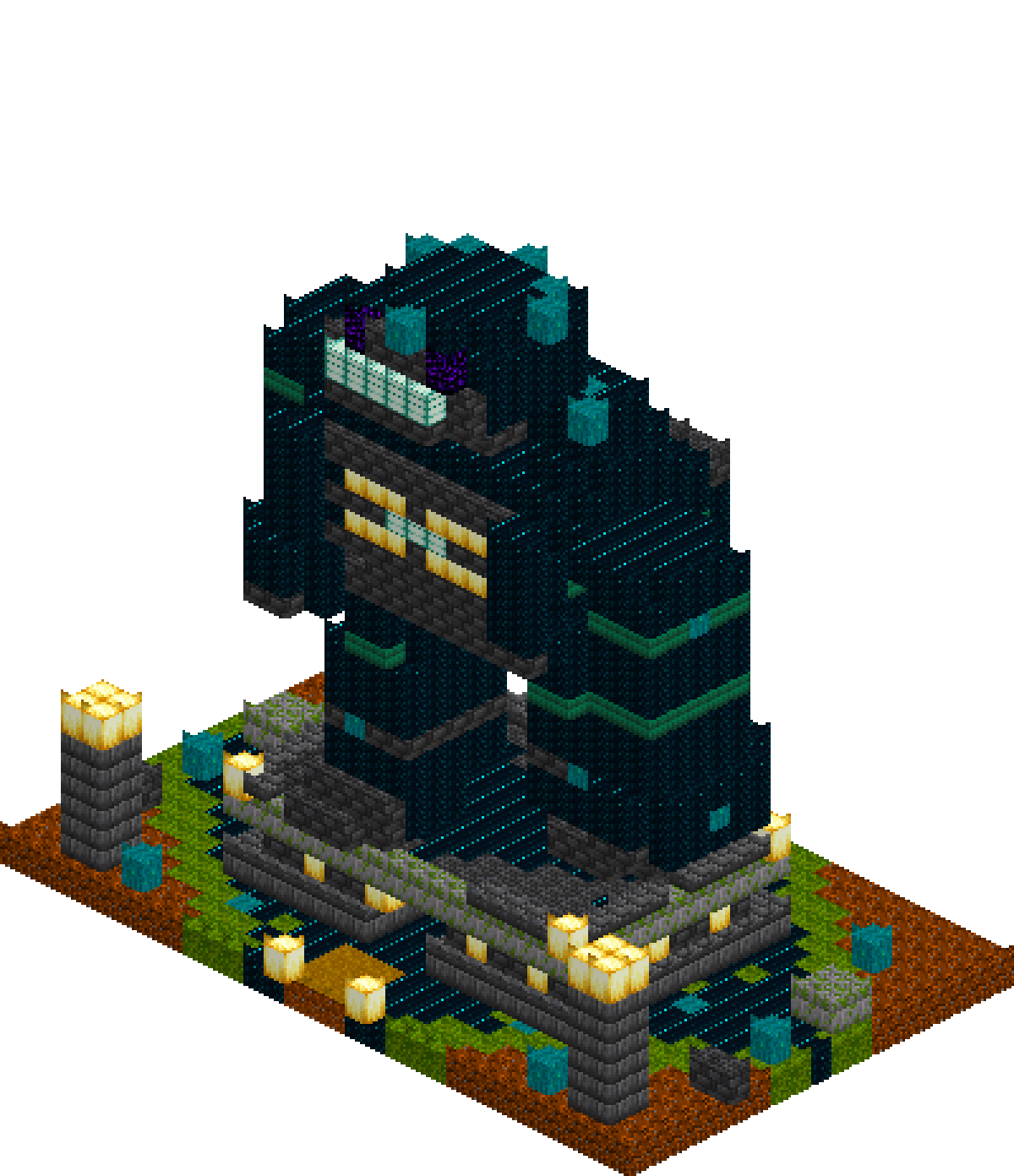
Nothing in Minecraft carries dread like a warden, and nothing collapses into a shapeless lump faster than a statue built solid. This one is read from its holes: three blocks of daylight between the striding legs, a two-block channel of air between each hanging arm and the ribs, a neck far narrower than the shoulders it rises from and the head it carries. The chest is a lit cage — froglight banded between deepslate ribs with a sea lantern heart — and a hollow shrine sits inside the plinth under its feet.
What you need
| Block | Count |
|---|---|
| Sculk | 2069 |
| Deepslate tiles | 374 |
| Deepslate bricks | 171 |
| Coarse dirt | 136 |
| Moss block | 110 |
| Mossy stone bricks | 95 |
| Dark prismarine | 70 |
| Froglight | 50 |
| Warped wart block | 49 |
| Deepslate bricks slab | 26 |
| Dirt path | 9 |
| Sea lantern | 8 |
| Crying obsidian | 2 |
Counts are exact for the model above. Mine a little spare — nobody places every block first time.
Building it
Each stage names the layers it covers. Drag the slider on the model to that layer and you are looking at exactly what the stage describes.
1.Ground, plinth and the shrine inside it
Lay the setting first: one flat layer of sculk fading out through moss to coarse dirt, with a three-wide dirt path walking in from the front and a froglight either side of it. The plinth is three courses with a deliberate profile — a wide deepslate brick base at y=1, a narrower deepslate tile body at y=2-3, then a brick cap at y=4 that oversails again. That step in and back out is the whole difference between a plinth and a crate. Hollow the body into an 11x5 shrine with three blocks of headroom, cut a doorway through the front wall, hang froglight under the ceiling, and set more froglight in an even rhythm around the outside face.
2.Feet and shins: build the stride
Both legs are four wide and five deep, but they do not stand level. The left is pushed forward to z=9-14 and the right left back at z=4-9, so from any three-quarter view you look between them instead of at one leg hiding the other. Keep x=14-16 completely empty from the cap up to the hips: eleven blocks of daylight, three wide, straight through the figure. Deepslate tiles cap the toes and claw one row further forward, a tile band at y=9 breaks each shin, and dark prismarine knee caps sit on the front face at y=13. The hips close over both thighs at y=16 and immediately pinch to a seven-wide waist.
3.Arms hung clear of the ribs
The arms are the test. Each is a three-wide, five-deep column running from the knuckles at y=11 up to the shoulder at y=22, and the columns at x=7-8 and x=22-23 must stay air for that entire run — a nine-block slot of open sky between arm and ribs on both sides. Nothing bridges it until y=23, where the deltoids reach inward and meet the torso in a single layer. Mirror the stride: left arm swings back with the right leg, right arm forward. Fists are one wider and two deeper than the forearm so the knuckles read, and dark prismarine bands at y=17 and y=21 stop each arm being a blank slab.
4.The chest and its lit ribcage
The torso flares to thirteen wide and nine deep, far broader than the nine-wide hips — that ratio is what makes a warden a warden rather than a golem. Build the mass, then band the front at z=13: deepslate tile ribs at y=19, 21 and 23, froglight rows at y=20 and y=22, a tile sternum down x=15 splitting each glowing row into two slots, and a sea lantern heart set into the middle rib. Keep the glow flush with the chest face rather than recessed behind projecting bars, or the light vanishes from every angle except head-on. Pectoral slabs at x=9-10 and x=20-21 stand one block proud to frame it, and a warped wart spine climbs the back.
5.Neck, shoulder humps and the hunch
Everything narrows hard here. The neck is three by three at x=14-16, sitting on a torso fifteen wide, and that jump is the entire trick — a four-wide neck kills the head instantly. Two shoulder humps flank it at x=10-12 and x=18-20 with air left at x=13 and x=17, so the silhouette reads as three separate masses rather than one shelf. Cap the humps with warped wart block for the glowing sensor tendrils, and stop them at y=27 while the neck carries on alone.
6.The head, and a face with no eyes
Seven wide, eight deep, four tall, and pushed forward to z=15 so it overhangs the neck by four blocks. That undercut beneath the jaw is what makes the head look hung rather than stacked, and it is the first thing people leave out. The jaw is deepslate tiles; the mouth is a five-block sea lantern slot at y=29 on the front face, and that single glowing line is what turns a box into a face. Two crying obsidian blocks at y=30 sit where eyes would be and read as sockets precisely because they do not glow. Finish with warped wart tendrils sprouting off the crown at y=31.
Make it yours
- Build the plinth, the legs and the arms, then walk twenty blocks back and look. If the gaps have visually closed from there, widen them before you place a single detail block — no amount of trim rescues a solid silhouette.
- Sculk is nearly black and swallows shape, so every band is structural rather than decorative. The deepslate tile courses at y=9, 16, 17 and 24 are what stop the whole figure flattening into one dark lump.
- Froglight is bright enough to light the shrine through the plinth roof, so if the interior is dim add sconces to the inner walls at y=2 instead of stuffing more light into the chest, which blows the ribs out.
- Face the statue toward whatever direction players approach from. The lit ribcage is the strongest thing on the build and it only exists on one side.
- Swap froglight for shroomlight if you want the ribs burning orange instead of gold, and crying obsidian for tinted glass if you would rather the sockets read as hollow than as wet.