How to build the Ice Palace in Minecraft
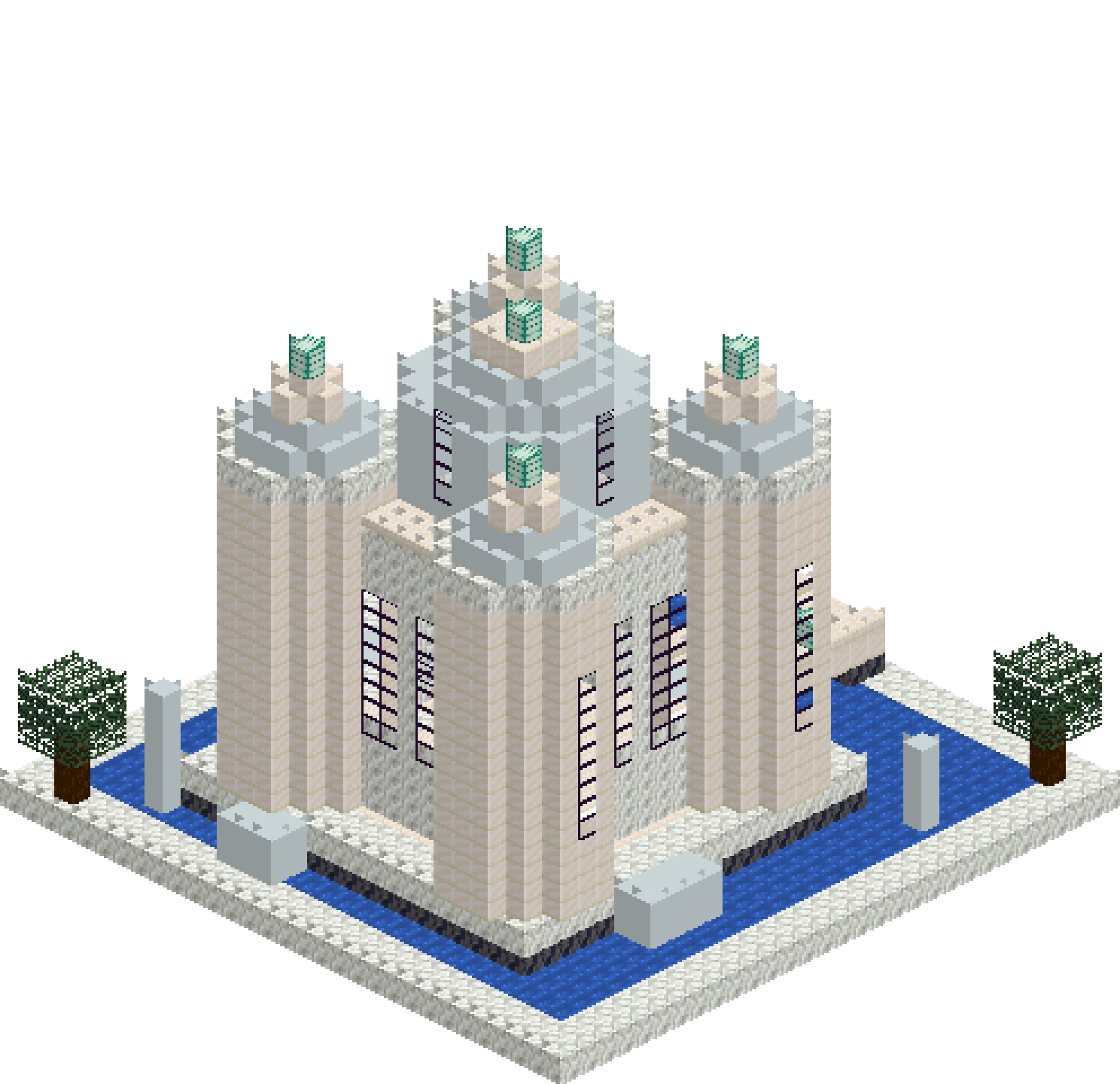
An ice palace is a colour problem more than a shape problem. Everything is white, so the build lives or dies on how many different whites you use — calcite is faintly grey and speckled, quartz is warm, white concrete is flat and bright, and tinted glass supplies the only cold shadow on the elevation. This one stands on a dark basalt plinth cut into a frozen moat, reached by a lit bridge, with four octagonal towers tapering into needles and a taller spire over the hall. It reads as ice from a hundred blocks away and holds up close, which is the whole trick.
What you need
| Block | Count |
|---|---|
| Quartz block | 2855 |
| Calcite | 809 |
| Smooth basalt | 748 |
| White concrete | 518 |
| Water | 340 |
| Tinted glass | 215 |
| Quartz block slab | 71 |
| Spruce leaves | 52 |
| Sea lantern | 35 |
| Spruce log | 8 |
Counts are exact for the model above. Mine a little spare — nobody places every block first time.
Building it
Each stage names the layers it covers. Drag the slider on the model to that layer and you are looking at exactly what the stage describes.
1.Frozen plain, moat and plinth
Floor the whole 31x31 plot in calcite, then cut a moat straight into it with one box of water — the calcite that survives around the edge becomes the shoreline, and you never have to draw a bank by hand. The palace stands on a 19x19 plinth of smooth basalt two blocks deep, capped with calcite and inlaid with a quartz panel so the terrace is not one flat tone. That dark band is doing real work: white on white has no bottom edge, and basalt sunk into water gives the whole palace somewhere to stand. Finish the setting with a few white concrete spikes rising out of the moat and two frost-laden spruces on the far shore.
2.The bridge and the approach
The way in crosses the water rather than skirting it, which is most of the drama for very few blocks. A quartz deck runs at terrace height from the plot edge to the plinth, carried on a basalt abutment at the shore and a single narrow pier midway, so there is open water visible under the span. Line both sides with quartz slabs — a half-height parapet reads as a handrail and keeps the deck from looking like a plank. Swap two parapet blocks for sea lanterns above the pier; at night they pick out the crossing before you see the palace at all. A short white concrete threshold carries the path onto the forecourt.
3.The great hall
A single hollow calcite box, 13x13 in plan and fifteen blocks tall, is the whole body of the palace. Hollow it, then clear the inside again to be certain, and lay a quartz floor so the interior tone shifts under your feet. Calcite against the quartz towers to come is a subtle contrast, but at this scale subtle is right — two whites, not two colours. Cap it with a ring of quartz slabs at y18. Place that parapet now, before the towers go in: the towers are drawn afterwards and simply overwrite the slabs where they pass through, which saves you cutting four notches by hand.
4.Four octagonal towers
Round towers are what separate an ice palace from a white castle, and you get one from three crossed boxes on a shared centre: 7 wide by 3 deep, 5 by 5, then 3 by 7. The union is a clean seven-wide octagon with no corner to catch the light wrongly. Sit one on each corner of the hall so the shaft swallows the wall junction, and run them to y19 — six blocks proud of the roof, so the silhouette steps up from terrace to hall to tower. Quartz here, against the calcite hall, gives the massing a warmer core and a cooler shell.
5.Portal, glazing and frozen falls
Push a calcite portal one block proud of the front wall, then cut the doorway through portal and wall in one clear so the reveal is two blocks deep. A slab cornice above it and a sea lantern set into each jamb finish the entrance. Glaze with tinted glass, never plain glass — it is the only dark block on the whole elevation, so it defines every opening. Give the hall a tall window on each free wall with a calcite mullion up the middle, and cut a nine-block slit into each tower face. Then spill white concrete off three terrace edges into the water as frozen cascades, so the palace looks like it is bleeding ice.
6.Spires drawn as layer rings
The central tower starts on the hall roof as a solid nine-wide octagon two courses deep, then continues as a hollow ring — one layer per level, each a cross-section you can read like graph paper. Set tinted glass at the four cardinal points and float a sea lantern inside, and the shaft becomes a lit lantern. Above y23 the rings step 9, 7, 5, 3 to a lantern pinnacle at the very top of the build. The corner towers taper in the same rings on the same layers: a calcite cornice at 7 wide, a drum at 5, a 3x3, a cross, a single block, then a sea lantern finial. Four spires, one op per level.
7.Cold light inside
The hall is thirteen blocks of headroom under a quartz ceiling, with the towers intruding as rounded piers in each corner — leave those, they look structural. Sink a panel of sea lanterns into the ceiling directly under the central spire so the light appears to fall down the shaft. Run a line of lanterns along the top of each side wall at y14: a cove throws light up the wall instead of glaring at eye level, and it backlights the tinted glass from inside. At the far end, a two-step calcite dais with a tinted glass screen against the back window gives the room something to walk towards.
Make it yours
- Calcite, quartz and white concrete are three different whites — speckled grey, warm, and flat bright. Band them by element (hall, towers, spires) rather than sprinkling them, or the palace dissolves into static.
- Tinted glass is the only dark block on the elevation, so spend it where you want the eye to go: the tall windows, the four spire faces and the throne screen. Ordinary glass simply vanishes against white.
- Place the roof parapet before the corner towers. The towers are drawn later and overwrite the slabs where they pass through, which saves cutting four notches by hand afterwards.
- An octagon is three crossed boxes on one centre — 7x3, 5x5, 3x7. Work it out once and every tower, drum and spire in the build comes from the same three numbers.
- Sea lanterns read cold and do not tint the white the way torches do. Under the ceiling, along the wall tops and at every spire tip, the palace glows blue-white at night instead of orange.