How to build the Market Stalls in Minecraft
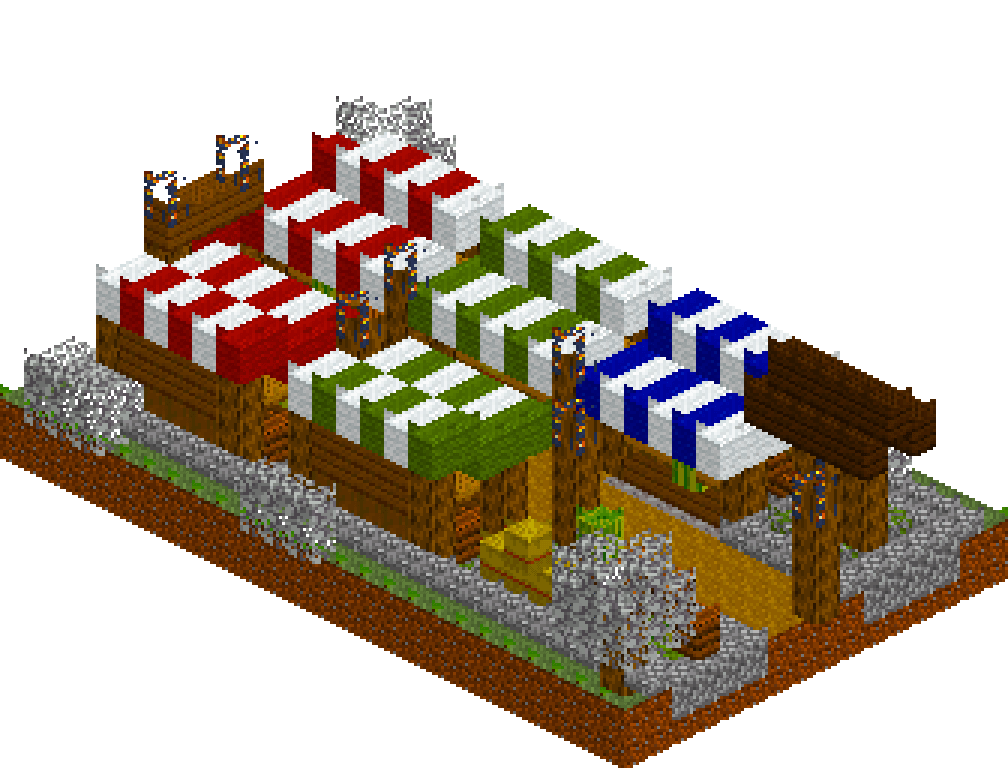
Most villages have a road, some houses, and nowhere to actually trade. This is a full square: five timber stalls under striped wool awnings on log posts, counters heaped with melons and pumpkins, crates and hay stacked behind, a cobbled floor worn through by a dirt path, and a mossy well under a dark oak canopy at the east end. It sits low and wide, so it slots into an existing settlement without shouting over your houses, and one stall is a six-block module — learn it once and you can line a whole street with them.
What you need
| Block | Count |
|---|---|
| Dirt | 416 |
| Cobblestone | 142 |
| Oak log | 110 |
| Grass block | 104 |
| Dirt path | 89 |
| Spruce planks | 79 |
| White wool | 77 |
| Oak leaves | 76 |
| Cobblestone slab | 60 |
| Mossy cobblestone | 54 |
| Oak planks slab | 43 |
| Red wool | 31 |
| Green wool | 30 |
| Gravel | 21 |
| Stripped spruce log | 20 |
| Lantern | 18 |
| Composter | 17 |
| Blue wool | 15 |
| Dark oak planks | 15 |
| Hay block | 13 |
| Andesite | 12 |
| Melon | 9 |
| Moss block | 6 |
| Pumpkin | 4 |
| Spruce log | 3 |
| Crafting table | 2 |
| Furnace | 1 |
| Water | 1 |
Counts are exact for the model above. Mine a little spare — nobody places every block first time.
Building it
Each stage names the layers it covers. Drag the slider on the model to that layer and you are looking at exactly what the stage describes.
1.The square underfoot
Dirt at y=0, grass over the whole footprint at y=1, then cobblestone across z=2 to z=13 — that is the trading floor. Break it before you build anything on it: mossy cobble under the western stalls and along the south-east, andesite where the middle stall stands, gravel worn through in the north-east corner. The dirt path runs the full length at z=6 to z=9 and leaves the footprint at both ends, so the square reads as somewhere you pass through rather than a box dropped on the grass. Gravel scuffs along both path edges finish the wear.
2.Frames, counters and the well ring
Cobblestone slabs at z=1 and z=14 kerb the plaza so grass never meets cobble in a hard line. Oak logs go in at both ends of every stall — x=1 and 6, x=8 and 13, x=15 and 20 on the north row — with spruce plank backs between them and a plank counter body along the front. Fill the shelf row with composters, hay and melons standing in for crates, and slip a furnace into one back wall and a crafting table into another so the stalls read as different trades. The well is a mossy cobble ring around one water block, held off the path by a slab surround.
3.Counter tops, shelves and the wall band
Counter tops are oak slabs with produce set straight into the run — melon, slab, pumpkin, slab — rather than perched on top. A full cube beside a half slab reads as goods heaped up; the same cube sat on a slab floats and looks placed. A band of stripped spruce log across the back walls at y=3 breaks the plank face for two ops, and a slab shelf at y=4 gives each stall an inside worth looking into. Lanterns land on the counter corners at y=4 and hang from the shelf line at y=5, which is exactly where someone working the stall would want them.
4.Striped awnings on a shed slope
The awning is the whole build, so make it step. A spruce plank beam caps the back posts at y=5, then wool goes down in two courses: y=5 over the front three rows, overhanging the counter by one, and y=6 over the back two. A single flat sheet at one height reads as a wool roof; the step reads as canvas pulled tight over a frame. Give each stall its own pair — red and white, green and white, blue and white — and start the opposite row on the off colour so the two sides never mirror. Lamp posts in the gaps cap out with lanterns at y=6.
5.Well canopy and the west gate
A spruce log beam bridges the well posts at y=6 with a lantern hung beneath it over the water. Above that, a dark oak gable at y=7 spanning three across rises one course to a ridge at y=8 — the tallest thing here, and dark against all that wool. At the far end, two oak posts and a spruce lintel frame the path entrance, a red and white banner hangs under it, and lanterns sit on top at y=7. Two ends, two markers, and the silhouette stops being a flat row of tents.
6.Trees, hedging and the worn edges
Two small oaks on opposite corner verges take leaf mass up to y=6 so the awnings are not the only thing at that height — build the canopy as a 3x2x3 block with a cross on top rather than a solid cube, and run the trunk in afterwards so it cuts back through. Hedge clumps sit on the grass strips at z=0 and z=15, a low cobble planter fills the gap beside the well, and moss spreads under the stacked crates. A last lamp post at the east entrance means both ways in are lit.
Make it yours
- The awning only reads as fabric because it steps — one wool course at y=5 over the front rows, another at y=6 over the back. Lay it all at one height and you have built a wool roof, not a canopy.
- Give every stall its own stripe pair and start the row opposite on the off colour. Identical stripes all the way down makes five stalls look like one very long tent.
- Sit melons and pumpkins directly in the counter run at y=3 beside the slabs, never on top of them. A block on a slab floats half a block clear and instantly looks decorated rather than sold.
- Let the dirt path run out past the footprint in both directions. A path that starts and stops inside the build tells everyone the square is an island with nothing either side of it.
- Keep mossy cobble where damp and shade would actually collect — under the awnings, around the well ring, beneath the stacked crates. Sprinkled evenly across the plaza it just reads as noise.