How to build the Underwater Observation Dome in Minecraft
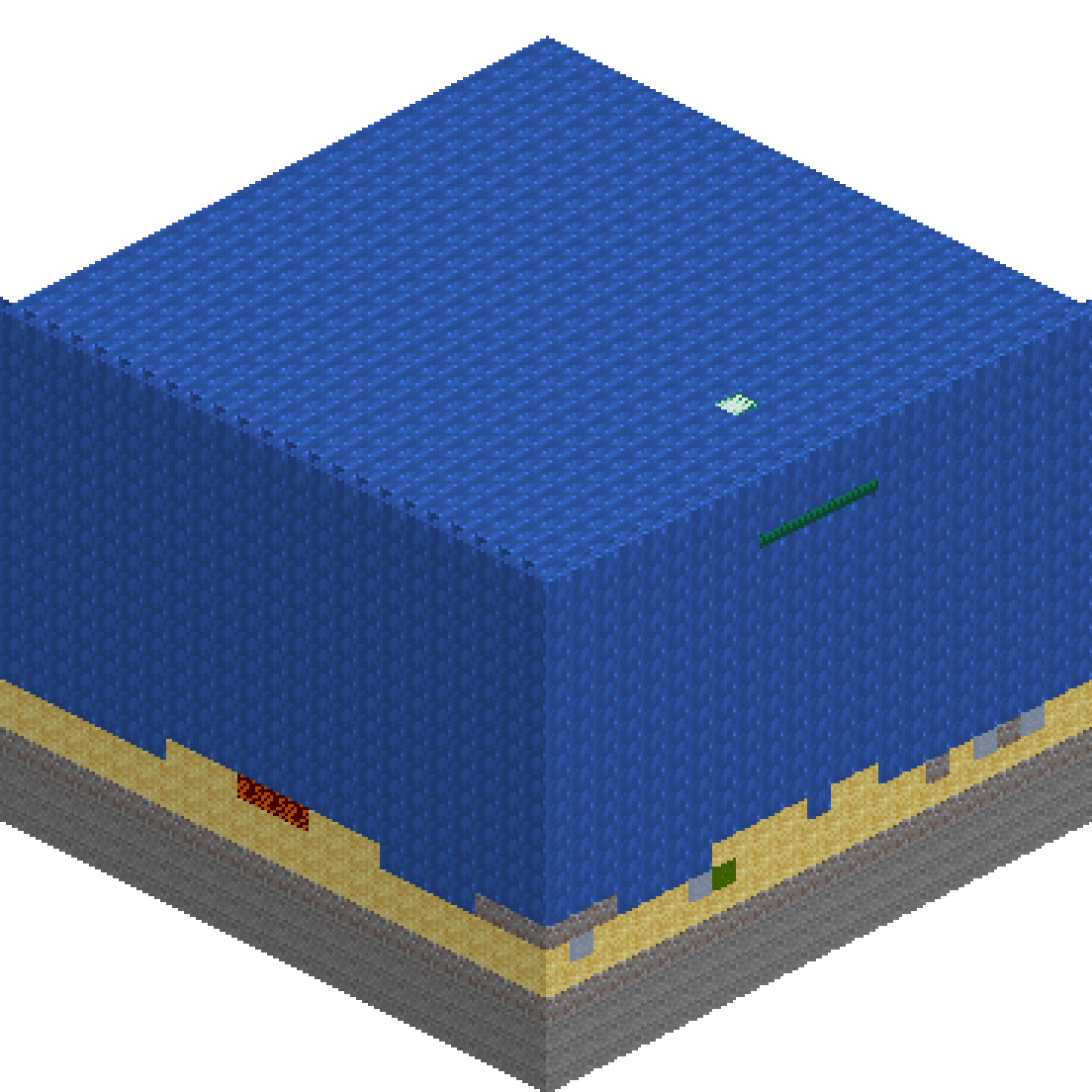
Most underwater builds are a box with windows. This one is a proper hemisphere - nineteen blocks across, ribbed in dark prismarine, sitting on a ring buried two courses deep in the sand so it reads as lowered into place rather than dropped on top. The floor glows: sea lanterns in concentric rings, throwing light up through the room and out into the water, which is what makes the surrounding sea read as deep rather than as a blue filter. A turret on the east flank carries the airlock and a spiral stair up to a glazed lookout above the glass.
What you need
| Block | Count |
|---|---|
| Water | 5643 |
| Stone | 1599 |
| Sand | 738 |
| Gravel | 557 |
| Dark prismarine | 358 |
| Prismarine bricks | 289 |
| Glass | 288 |
| Prismarine | 104 |
| Dark prismarine slab | 80 |
| Sea lantern | 76 |
| Clay | 8 |
| Nether wart block | 8 |
| Warped wart block | 8 |
| Prismarine slab | 8 |
| Moss block | 5 |
| Magma block | 3 |
| Dripstone block | 1 |
Counts are exact for the model above. Mine a little spare — nobody places every block first time.
Building it
Each stage names the layers it covers. Drag the slider on the model to that layer and you are looking at exactly what the stage describes.
1.Seabed, sand line and buried footings
Everything measures off the sand line at y=5. Lay stone to y=2, one band of gravel at y=3, then two of sand. In a real ocean you do this in reverse: pick your sand line, then dig down two courses across a twenty-one block circle so the ring has something to sit in. The dig is the whole point. A dome that sits on the seabed looks dropped there; a dome sunk into it looks moored, and the difference costs you about ninety blocks of sand.
2.The ring, the kerb and the lantern floor
The ring is one annulus, radius 9 to 10, in three materials: rough prismarine for the buried courses at y=3 and y=4, prismarine bricks at the sand line, dark prismarine at y=6 for the single course that shows. Swap the ring to dark prismarine at the eight compass points - those are the feet of the ribs and you want them reading through the sand. Inside, the floor at y=5 is concentric: a sea lantern core, prismarine bricks, a dark band at radius 4, then a dashed lantern ring at radius 6 laid on alternate blocks so it reads as pattern rather than stripe. At y=6 the kerb steps in twice, dark prismarine slabs at radius 7 and full blocks beyond, which leaves a two-tier bench ringing the room at exactly the height you sit and look out.
3.Springing the glass
Glass springs from y=7 at radius 9 and stays near-vertical for three courses - 9, 9, 8.9 - before it leans in. That short drum is the trick: it puts standing eye level at y=7 against flat glass instead of against a slope, so you look straight out across the sand rather than down at your own feet. Lay each course as a ring, then thicken it wherever the course above steps inward, or you get a hairline gap along every step and the sea finds it. Replace glass with dark prismarine on the eight meridians as you climb, and at y=9 swap the rib block on each meridian for a sea lantern. Those beads are the only light above head height and they carry the whole exterior.
4.Closing the dome
Radii from y=11 up: 8.1, 7.3, 6.2, 4.6, then a cap at 2.4. Round to whole blocks as you place - the numbers say where the curve should be, they are not block counts. Two courses matter. At y=14 the ring runs two thick in places because the cap above pulls in by more than one block, and that extra thickness is what seals the step. At y=15 stop laying glass: the cap is solid dark prismarine with a five-block sea lantern oculus, so the eight ribs arrive somewhere instead of petering out. Finish with one dark prismarine block at y=16 and a sea lantern at y=17 - a lamp on a short stalk, visible a long way off underwater.
5.The airlock and its spiral stair
The turret is a five by five hollow shell of prismarine bricks from y=6 to y=17, driven through the east flank so its outer wall replaces glass rather than clashing with it. Build it after the dome is closed and let it overwrite; leaving a hole for it first is how you end up with a leak you cannot find. Hollow the inner three by three from y=7 up, cut a three-wide door through the west wall at y=7 to 9, and frame it in dark prismarine with a lantern in each jamb. That is the airlock - the dome floor sits at y=5 and the turret floor at y=6, so there is a real threshold to step over, with a slab on the dome side to halve it. The stair is eight prismarine slabs walking the inside wall of the shaft, one up and one round each time, to a landing at y=13.
6.The lookout cap and the crown lamp
Above the landing, swap the turret walls at y=14 to 16 for glass and keep the four corners dark prismarine. That glazed lantern room sits three blocks proud of the dome apex and is the only spot on the build where you look down onto the glass. Ceiling in dark prismarine at y=17, with a sea lantern tucked under it. The cap is dark prismarine slabs at y=18 laid as a cross rather than a full seven by seven square - clipping the corners stops it reading as a lid. A two-block mast and one more sea lantern at y=20 finishes it, close enough to the surface that the light carries up.
7.Marker posts, drift and letting the sea in
Four prismarine brick posts at the diagonals, five tall, each with a sea lantern on top. They cost nothing and they are what makes the dome read as large: the eye needs something of known size standing beside it, and in open water there is nothing else. Drift sand against the ring at y=6 in a broken band, thickest where it meets stone and thinning to nothing a block and a half out. Break the rest with a stone outcrop, a gravel patch, clumps of nether wart block and warped wart block for coral, and a line of magma at the edge for a bubble column. Then flood it - water from y=6 to y=20, and leave the top course air so the surface plane shows. Without that plane the sea has no ceiling and the depth stops reading.
Make it yours
- Build the dome dry inside a shell of sand or gravel and mine the temporary blocks away from outside once the glass is closed. Placing glass against live water block by block costs three times the time and you will still miss one.
- Sponges are the fast way to drain the interior: place, let it soak, break it, dry it in a furnace, repeat. Clear an ocean monument first and you walk away with the prismarine, the sponges and the crystals for a conduit in one trip.
- Sea lanterns are the only sensible light down here - full brightness, no support block, and they sit in the structure instead of hanging off it. Get them into the floor rings and the ribs before you close the shell, because retrofitting light means breaking glass and draining the room again.
- Prismarine, prismarine bricks and dark prismarine read as one material at distance and as three up close. Use the roughest where it meets sand, the darkest for the course that shows above it, and never let a single tone run more than two courses.
- If it leaks while you work, do not hunt block by block - stand inside and look for the current, then check the diagonal steps. A ring that pulls in two blocks between courses leaves a corner gap every time unless you thicken the lower course.
- A conduit activates on a sixteen-block prismarine frame two blocks out from it, and a full forty-two-block frame pushes its range to ninety-six - more than enough to cover the dome and the sand around it while you work.